
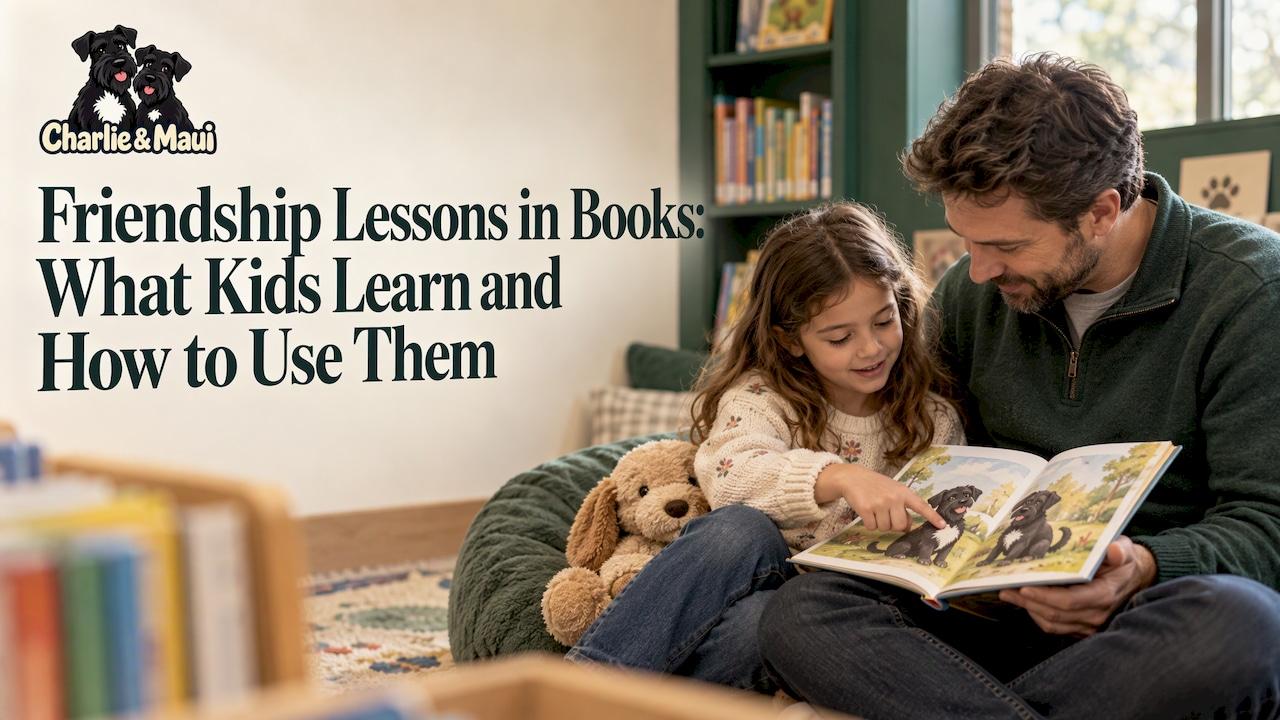
Children learn friendship best when a story lets them watch a friend make a choice, feel the result, and then talk about it with a grown-up. The strongest friendship books pair characters a child loves, often animals, with a few honest questions to ask afterward. Our Charlie and Maui books are built that way: two dogs, real adventures, and conversation questions, memory activities and author notes for ages 4 to 9 to read with an adult.
TL;DR
- Friendship books teach a handful of lessons again and again: how to make a friend, how to be kind, how to stay loyal, how to repair a quarrel, and how to cope when a friend is gone.
- Animal characters make these lessons easier for kids to talk about, because the feelings belong to the dog or the bear, not to the child.
- The lesson sticks when an adult asks before, during and after reading, not when the book is simply finished.
- Stories about loss belong on a friendship shelf, because losing a friend or pet is part of what friendship means.
- Charlie and Maui is our series of illustrated dog adventures with conversation questions and memory activities built in.
Table of Contents
- The friendship lessons children's books keep returning to
- Why animal friends work so well
- How to turn a friendship book into a real conversation
- When the friend is gone: loss belongs on the friendship shelf
- A quick checklist for choosing a friendship book
- Charlie and Maui: friendship and loss in one series
- Perspective
- FAQ
- Sources
The friendship lessons children's books keep returning to
Open any list of friendship picture books and the same themes appear. Knowing them helps you choose a book for the lesson your child needs this month, not just the cover.
How to make and keep a friend. In How to Be a Friend by Laurie Krasny Brown and Marc Brown, dinosaur characters show the value of friends, how to make them, and how to be a good or poor friend. Eric Carle's Friends covers the harder side: a boy whose best friend moves away.
Kindness as a choice. PBS KIDS for Parents highlights I Walk with Vanessa, a wordless book where one girl walking beside a bullied classmate changes the day. In If You Plant a Seed, Rabbit and Mouse choose between seeds of selfishness and seeds of kindness. Kids see that kindness is something you decide, often in a small moment.
Loyalty and courage. Literacy Worldwide's list of best-friend books includes The Last Place on Earth, a story of courage and loyalty to friends, and Monkey and Elephant and the Babysitting Adventure, which ends with the friends promising to stay best friends.
Sharing what you have. The Learning to Give guide for Two Bobbies frames the story around the idea that each pet had exactly what the other needed, and asks children to list their own good traits to share with a friend.
Losing a friend. Ida, Always tells the true story of two polar bears at New York's Central Park Zoo. When Ida dies, Gus is lonely but held up by memories, a gentle lesson on friendship and loss.

Why animal friends work so well
A child who is shy about a fight with a classmate will often happily explain why a dog was wrong to snatch a bone. The animal holds the feeling at a safe distance. That distance is what lets a four-year-old say "he felt left out" before they can say "I felt left out."
Animal adventures also give friendship something to do. In Gooseberry Park by Cynthia Rylant, a loyal Labrador, a bat, a hermit crab and a squirrel mother risk everything to reunite a mother squirrel with her babies after an ice storm. Friends are shown through action: they show up, they work as a team, they take a risk for someone else.
The bond between a child and a pet is often a child's first close friendship. A book about two dogs can speak directly to a child who has a dog at home, or who wishes for one. Our guide to teaching kindness through stories goes deeper on that link.

How to turn a friendship book into a real conversation
A lesson named by an adult tends to bounce off. A lesson a child finds through a question tends to stay. A simple three-part routine works for parents and classroom teachers alike. The Learning to Give guide for Two Bobbies is organized the same way, with before-, during- and after-reading questions for parents, teachers and group leaders.
- Before reading. Look at the cover and ask what kind of friends these two might be. Ask what makes someone a good friend. You are collecting the child's own ideas first.
- During reading. Pause at a turning point, such as a quarrel or a rescue. Ask, "What do you think will happen next?" and "How does she feel right now?" Keep pauses short so the story keeps moving.
- After reading. Ask what the characters did that a good friend would do, and whether the child has ever felt the same way. Then connect it to a small action: write a note to a friend, list acts of kindness, or help at a local animal shelter, as the Two Bobbies guide suggests.
For more prompts that open a child up, see our read-aloud discussion questions and our piece on reading for feelings.
Matching the book to the age
For ages 4 to 5, choose short picture books with one clear lesson and lots of pictures, and expect to reread them many times. Our list of books to read aloud to 5 year olds can help. For ages 6 to 9, look for stories with a problem that takes several pages to solve, where friends disagree, make mistakes and make up.
When the friend is gone: loss belongs on the friendship shelf
At some point most children lose a friend, whether through a move, a falling out, or the death of a pet. Books are a gentle way into that conversation. Here is what the research and extension sources agree on.
- Use plain words. The Learning to Give guide to The Tenth Good Thing About Barney advises honesty without euphemisms, using words like death and dying, and not hiding your own grief.
- Be concrete. South Dakota State University Extension suggests explaining death as no longer breathing and no longer having a heartbeat.
- Follow the child's lead. The same extension page advises inviting questions, and if you don't know an answer, saying something like "You know, I wonder about that too."
- Make a memorial. Drawings, poems, planting a tree or a memory box give grief somewhere to go. The Memory Box by Joanna Rowland is built around exactly that idea.
- Know your age range. Nebraska's Read for Resilience program lists The Tenth Good Thing about Barney for children 6 and older, with free reading guides that give adults suggested activities and probing questions.
If a pet has died and you need support yourself, the ASPCA Pet Loss Hotline is listed at (877) 474-3310 in the Learning to Give guide. For a child who seems stuck in distress for a long time, talk to your pediatrician or a child counselor.
We have written more on this in explaining pet death to kids, remembering a pet with kids and how children understand death at every age.
A quick checklist for choosing a friendship book
| What to look for | Why it helps |
|---|---|
| One clear friendship lesson | Young kids hold onto a single idea better than several |
| Characters who make mistakes | Kids learn repair, not just perfection |
| Animal or familiar characters | Feelings are easier to name at a distance |
| Built-in questions or activities | The conversation does not depend on your improvising |
| Honest treatment of hard feelings | Kids trust books that do not skip sadness |
| A reading level you can share | Ages 4 to 9 are best read with an adult |
Charlie and Maui: friendship and loss in one series
Charlie and Maui follows two dogs through adventures that touch on curiosity, kindness and friendship, and also on loss and remembrance, including a story of a dog coping with the death of a friend. Each book includes an illustrated story, conversation questions, memory activities and author notes, made for ages 4 to 9 to read with an adult. Books are sold in print and digital through our site, Amazon and Barnes & Noble.

You can see the full line on our Charlie and Maui books page.
Perspective
We wrote these books because friendship is not only about the fun days. It is also about the day a friend is gone, and what you carry with you afterward.
I am a U.S. Navy veteran, and my own life, and my family's, are in these pages. Charlie and Maui are two dogs, but the feelings are ones people of any age know: curiosity, kindness, missing someone, remembering them well.
That is why every book comes with conversation questions and memory activities. A story is where the talk starts. We want a parent or teacher and a child to close the book and keep going, together.
Jake
FAQ
What friendship lessons do children's books teach?
Most cover how to make friends, kindness, loyalty, sharing, resolving conflict and coping when a friend leaves or dies. Picture books show these through characters' choices, which lets children see cause and effect without a lecture.
What age is right for friendship books about loss?
Children as young as 4 can share a simple, honest story with an adult, and some programs, such as Read for Resilience, list loss titles for ages 6 and up. Follow your child's questions and keep the reading together.
How do I start a talk about friendship after reading?
Ask open questions: what did the friend do that was kind, how did the other character feel, and has the child felt that way. Our read-aloud discussion questions give more starters.
Why use animal stories to teach friendship?
Animals let children discuss feelings without pointing at themselves. Stories like Gooseberry Park show loyalty and teamwork through animal characters kids already love.
Sources
- Recommended Children's Books, The Center for Parenting Education
- 15 Children's Books About Friendship, PBS KIDS for Parents
- Books About the Best of Friends, Literacy Worldwide
- Gooseberry Park, Read To Them
- Two Bobbies Literature Guide, Learning to Give
- The Tenth Good Thing About Barney Literature Guide, Learning to Give
- Losing Pets and Talking About Death, South Dakota State University Extension
- Read for Resilience, University of Nebraska–Lincoln