
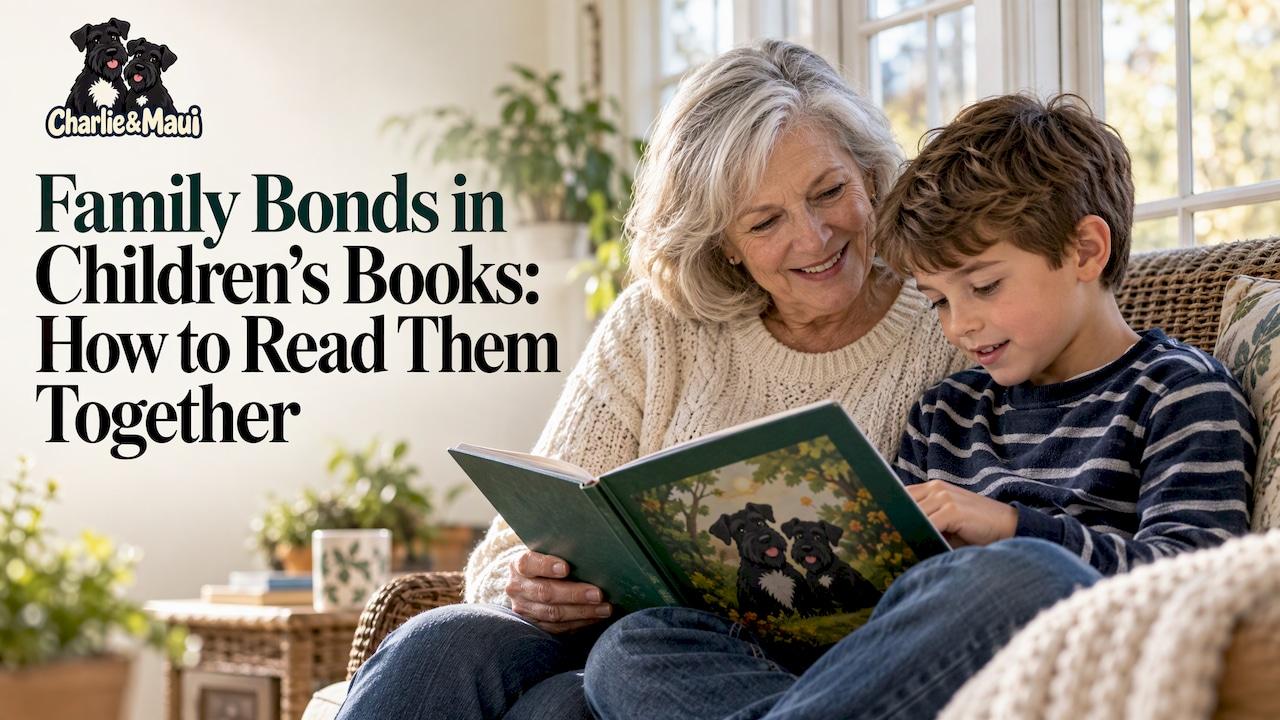
The best children's books about family bonds do two things at once: they show a child what care between people looks like, and they give the adult a way into a conversation. Picture books cover parents, siblings, blended families, adoption and pets, and the ones that work hardest for you pair a warm story with something to talk about afterward. That is how we build the Charlie and Maui books: two dogs on an adventure, with conversation questions, memory activities and author notes included for ages 4 to 9 to read with an adult.
This guide shows what kinds of family bonds children's books portray, how stories show a relationship growing, how to use a book to talk about friendship, conflict and loss, and which questions to ask when the last page is turned.
TL;DR
- Picture books show family bonds in many forms: parent and child, siblings, stepfamilies, adoption and chosen family, and pets who count as family.
- Stories show a bond growing through attention, trust and shared activity, so look for books where characters care for each other in specific, visible ways.
- Talking during and after the story, and linking it to your own family's history, is where the bonding happens.
- A story about a pet or friend who dies can give children words for loss and a safe place to remember.
- Open-ended questions work best. Ask what a character felt, what they wanted and what the family could do next.
Table of Contents
- The kinds of family bonds children's books show
- How stories show a family bond growing
- Reading together is where the bonding happens
- Questions to ask after a story about family bonds
- When the bond includes loss
- Where Charlie and Maui fit
- Our perspective on family stories
- FAQ
- Sources
The kinds of family bonds children's books show
Family in a picture book is rarely just one shape. The National Association for the Education of Young Children (NAEYC), the main U.S. professional body for early childhood educators, lists picture books for each kind of bond: parent and child (A Chair for My Mother, Daddy Makes the Best Spaghetti), siblings (Annie Rose Is My Little Sister, Jamaica Tag-Along), blended and varied families (The Family Book, which celebrates stepfamilies, two-mom and two-dad families and single-parent families), and pets (Fred Stays with Me!, about a girl whose parents are divorced and her misbehaving dog).
A federal early-childhood guide hosted by the University of Washington sorts diverse-family picture books by age band. It includes The Great Big Book of Families for Pre-K to grade 3, which features pets and family trees, and We Belong Together on adoption and chosen family. If you are choosing for a toddler, a preschooler or an early reader, those age labels save time.
Pets are part of the family circle
If your child loves animal stories, that is not a quirk. A 2021 study of 30 picture books by Calvo-Maturana and Forceville found that every book featured at least one animal, and many showed a pet as part of the family. In several, the tender scenes formed a triangle of one parent, the child and the pet.
That is why a dog-and-child story is a natural vehicle for family themes. A dog can be loyal, curious, jealous, brave or sad without the child feeling lectured. The bond between a child and a pet is simple enough to see clearly, and it opens the door to the harder, bigger bonds at home.
Who is missing from the shelf
Researchers who have counted are worth a glance if you are an educator building a classroom library. A content analysis of all 15 novels with human families on the 2019 to 2020 Iowa Children's Choice Award list found three themes: challenges that start inside the family, challenges that come from outside it, and patterns in who plays the single parent or guardian. The author concluded that most of the strong, supportive, independent adults in those families were female. Mixing your shelf so children see different kinds of adults caring for them is a simple fix.
How stories show a family bond growing
A good family story does not announce that people love each other. It shows the love through what they do. Three ingredients come up again and again.

Attention. A character notices what another character needs. A thesis from Illinois State University on two contemporary novels describes parent and child relationships as built on mutual care and quotes philosopher Amy Mullin: both must pay close attention to each other, trust each other enough to disclose who they are, and do things that respond to each person's needs and interests. Children read that more simply: someone listened, someone showed up.
Shared experience. Adventures, chores, trips, a trip to the vet, a rainy day. Bonds in stories deepen when characters go through something together and come back changed. This is the engine of a good animal adventure: two friends, a journey, a problem and a way home.
Care that lasts. A starred Kirkus Reviews review of The River of Caregiving describes a grandmother explaining that care connects each generation to the next, and notes that handmade clothing and fruit trees planted by family members who have died keep love flowing after death. It is a useful reminder that a family bond does not end when a person or a pet is gone, and picture books can say so gently.
What to look for when you choose
When you pick a book about family relationships, run through a short list:
- Is the bond shown through action? Look for characters who comfort, share, apologize or wait for each other.
- Does the story match your child's age? Ages 4 to 9 can handle a longer arc, a bit of sadness and a resolution that takes work. Our guides on choosing books for children and read-aloud books for 4-year-olds go deeper on age fit.
- Does it give you something to say? A book with a built-in way to talk afterward turns a bedtime read into a conversation.
- Does it look like your family, or the families your child will meet? Stepfamilies, single parents, grandparents and chosen family all deserve a place.
Reading together is where the bonding happens
The book is half the work. The other half is how you read it. In an ethnographic study of six Chinese American families with children ages 4 to 6, Ling Hao found that parents connected books to the children's lives, family history, heritage culture and experiences through discussion during and after reading. Nobody needed a script. The parents simply said, "That reminds me of when..."
Two more U.S. sources point the same way. Reading Rockets, a national literacy project, says that family-story projects help children learn heritage while strengthening literacy, and that listening to a parent's or grandparent's stories helps children learn how stories are built. PBS KIDS for Parents suggests taking turns adding sentences to a family story and telling a story from your own childhood, which also builds listening, communication, imagination and memory.
In practice, that means a story can start a second story: your own.
A simple routine
- Before: Look at the cover. Ask what the characters might be doing and why.
- During: Pause once or twice where a character makes a choice. Do not pause every page, or the story loses its pull.
- After: Ask one question, then wait. Let the silence do some of the work.
- Later: Bring the story back at dinner or in the car, linking it to something real.
For more ideas that turn reading into a habit, see our list of family reading activities, and for why this matters at all, the benefits of reading aloud.
Questions to ask after a story about family bonds
Open-ended questions give children room to think. A Scholastic Parents piece quoting a literacy expert says that open-ended questions build conversation and vocabulary because the child has to put together a full answer rather than say yes or no. Here are questions that suit a family story.
About feelings
- How do you think the character felt when that happened? How could you tell?
- Has there been a time you felt like that?
About the bond
- What did one character do to show they cared?
- Who helps you when you feel that way? How?
About friendship and conflict
- What did each character want? What made it harder?
- What could they do to fix it? What would you have done?
About memory and belonging
- Who in our family does this remind you of?
- What is a story from our family you would like to tell someone?
Educators have an extra advantage: children can talk about a character's choices before anyone asks them to reflect on their own. That makes a story about two friends who disagree a gentle way to open a class meeting on sharing, fairness and making amends. Our guide to emotional learning through stories shows how to read for feelings in this way.
When the bond includes loss
Family bonds include goodbyes. A pet dies, a grandparent is gone, a friend moves away. Children meet these moments early, and a story is often the easiest way to start talking about them.
The key is pace. Read when there is time to stop. Let your child lead: some will ask five questions, some will say nothing and ask the next day. Read the book first yourself so you know which pages are hard. If a child shows signs of distress that last or get in the way of daily life, the right person to talk to is your child's pediatrician or a licensed child therapist.
Our guides on grief in children's books, helping a child grieve and remembering a pet with kids cover what to say and do. For a wider look at how children experience loss, this resource on supporting children through grief is a good companion.
Memory is the part of grief that families can do something with. Drawing a favorite moment, telling the funniest story about the one who is gone, or choosing an object to keep are all ways a child can hold on to love while accepting that someone is gone. Stories that include a memory activity turn that idea into a next step.

Where Charlie and Maui fit
Charlie and Maui are two dogs whose journeys carry the themes in this guide: curiosity, kindness, friendship and family connection. One story follows a dog coping with the death of a friend, which gives families a way into conversations about loss and memories. Each book includes an illustrated story, conversation questions, memory activities and author notes, made for ages 4 to 9 to read with an adult.
The stories come from Jake's own life as a U.S. Navy veteran and a family man, so the feelings in them are drawn from real experience rather than invented for the page. You can see the full line on the Charlie and Maui books page, where they are available in print and digital formats through the author's website and online retailers.

If you are a teacher, the conversation questions work as a ready-made discussion guide. If you are a parent, they are the first few lines of a talk you may not know how to begin.
Our perspective on family stories
When I write about Charlie and Maui, I am not trying to teach a child a lesson from the front of the room. I am trying to sit next to them with a book open and a dog on the page who feels something they recognize.
My years in the Navy and my family taught me that the people we love shape who we are, and that love shows up in small things: a shared walk, a quiet seat nearby, a story told twice because someone asked.
That is why each Charlie and Maui book has questions, memory activities and notes for the grown-up. The story starts the conversation. You and your child carry it on, in your own words, about your own family.
Dogs make this easier. A child can say what Maui is feeling long before they can say what they are feeling. And when a dog loses a friend, a child learns that sadness and remembering can sit side by side.
Jake
FAQ
What is the best book about family relationships for young children?
There is no single best book, because it depends on your child's age and your family. Start with the bond you want to talk about: parent and child, siblings, a blended family or a pet. Then choose a story that shows care through action and gives you something to discuss afterward. Our Charlie and Maui books are written for ages 4 to 9 with conversation questions in each one.
How do you create a bond with your kids through books?
Read together at a regular time and pause to talk, not just to finish. Link the story to your own life by sharing a memory or asking your child about theirs. Research and parent guidance from literacy groups point to this kind of shared talk, and taking turns adding to a story, as ways to deepen connection.
Can a story about a pet's death help a child grieve?
Yes, it can give a child words for loss and a safe place to feel it. Read the book first, choose a time when you can stop and talk, and let your child set the pace. If sadness lasts or disrupts daily life, speak with your child's pediatrician or a licensed child therapist.
What questions should I ask after reading a story about family?
Stick to open-ended ones: how a character felt, what they wanted, what they did to show they cared, and what your child would do. Then connect it home with a question such as "Who does this remind you of?" One good question and a patient pause beats a list of ten.
Sources
- Children's Books about Families, NAEYC
- Creating a Welcoming Early Childhood Program for Diverse Families, University of Washington
- The Depiction of Family and Self in Children's Picture Books
- Portrayal of Diverse Family Structures in Children's Literature, University of Northern Iowa
- Focalization thesis, Illinois State University
- The River of Caregiving, Kirkus Reviews
- Uplifting the Voices of Asian American Parents, Illinois State University
- Family Stories, Reading Rockets
- Reading and Sharing Stories, PBS KIDS for Parents
- 7 Important Questions to Ask Your Child During Story Time, Scholastic
- Supporting Children Through Grief, Memory Keep