
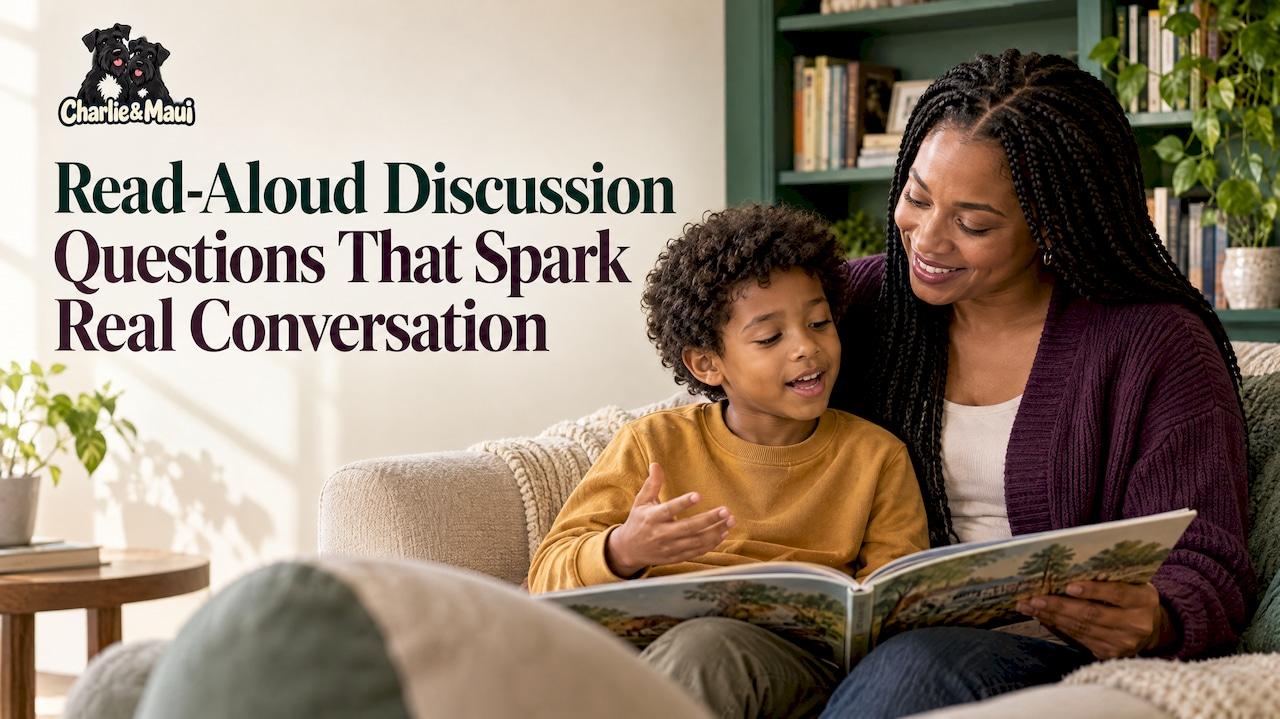
The best read-aloud discussion questions are short, open-ended and spread across the whole story: a few before you open the book, one every page or two while you read, and a handful once the last page is closed. Asked that way, they feel like talking about the story, not a quiz about it. Below you will find ready-to-use questions for each moment, how to adjust them for ages 4 to 9, and how to use the same approach for harder themes like friendship, kindness and loss.
TL;DR
- Ask in three moments: predictions before reading, a quick question every one to three pages during, and reactions and connections after.
- Prefer open-ended questions ("Why do you think...?") over ones with a single right answer, and follow your child's answer with "What makes you think that?"
- Prepare a few questions ahead, but let your child's comments lead. Skip questions on pages where the story is carrying them.
- For feelings-heavy stories about friendship or loss, ask what a character feels and what they might need, then share your own memories.
- Pick a book you can finish in one sitting: about 15 to 20 minutes for most children, 10 for preschoolers.
Table of Contents
- Why the questions matter more than the book list
- The three-moment method: before, during, after
- Questions to ask before reading
- Questions to ask during reading
- Questions to ask after reading
- Adjusting questions by age
- Questions for animal-adventure stories
- Talking about friendship and kindness
- Talking about loss and memories
- Keeping it a conversation, not a quiz
- A sample session, start to finish
- Our perspective
- Read the Charlie and Maui books together
- FAQ
- Sources
Why the questions matter more than the book list
A read-aloud is one of the few moments in the day when an adult and a child sit with the same story. Questions turn that shared time into a conversation: the child predicts, notices, worries about a character, and connects the story to their own life. The Reading Is Fundamental (RIF) read-aloud guide recommends preparing open-ended questions before you start, and choosing a book you can finish in one sitting, around 15 to 20 minutes for most children and 10 minutes for preschoolers.
If you are still deciding what to read, our guides to choosing books for children and to what reading aloud does for kids and families cover that side. This article is about what to say once the book is in your lap.
The three-moment method: before, during, after
Educators who teach interactive read-alouds tend to organize questions around the same three moments. You do not need all of them every time. Two or three good questions per moment is plenty.
| Moment | Goal | Example question |
|---|---|---|
| Before | Build curiosity and activate what the child already knows | What do you think this story is about? |
| During | Check understanding and keep attention | How do you think the character feels right now? |
| After | Connect, reflect and find the message | What was your favorite part, and why? |
Questions to ask before reading
Before-reading questions are about predictions and background knowledge. RIF's guide suggests showing the cover, naming the title, author and illustrator, reading the back-cover blurb, asking what children think the book is about and where it takes place, and asking whether they have read something similar. It also suggests making predictions from the illustrations without revealing the ending. The Children's Literacy Initiative adds that you can introduce key vocabulary and activate background knowledge at this stage, so the story does not stumble over unfamiliar words.
Try these:
- What do you see on the cover? What do you notice?
- What do you think this story might be about?
- Where do you think it takes place?
- Have you read a story like this before?
- What might you have in common with the characters?
- (For a pet story) Do you think these animals are friends already, or will they have to become friends?
Keep this part to a minute or two. Children get restless if the prediction chat is longer than the first page of story.
Questions to ask during reading
During reading, the aim is understanding without breaking the spell. Reading Partners' discussion guide advises asking one literal, inferential or vocabulary question every one to three pages, and asking children for evidence from the text when they answer.
Surface questions: what is happening?
The Institute of Education Sciences (IES) publishes sample questions for K-3 narrative texts that begin with the basics: Who are the main characters? Where does the story take place? What happened first? These are easy wins, especially for younger listeners, and they make sure everyone is following the plot.
Below-the-surface questions: why and how?
Inference questions ask children to read between the lines. Examples drawn from the IES list and Reading Partners' guide:
- How do you think the character feels? Why?
- Why do you think the character did that?
- What is the problem in this story? What is the character doing to solve it?
- What if something different had happened? How would that change things for the characters?
A WestEd and IES planning guide for Pre-K through first grade offers a handy ratio: pause for three or four surface questions, prepare three or four below-the-surface questions for the parts that carry the theme, and save one or two deeper questions for the author's purpose or how the illustrations add to the story. Read it as a menu, not a quota.
Sensory and pretend questions
Vanderbilt University's read-aloud program suggests inviting children to use their senses and imagine being a character: What did the character hear? What did the character smell? Pretend to be the character for a moment. These work especially well with animal stories, because children know how dogs sniff, listen and wag.

Expand, do not correct
When your child answers, build on it. The Pennsylvania Center for the Book suggests expanding children's answers rather than just saying "right." If a child says "the dog is sad," you might answer, "Yes, he is sad because his friend isn't there. Look at how his ears are down." That models the rich language you want them to use next time.
Questions to ask after reading
When the book closes, leave a moment of quiet before you speak. Vanderbilt's guide recommends creating time at the end for children's responses and reactions. Then try questions like those in RIF's after-reading list:
- What was your favorite part? Why?
- Who was the most important character? Why?
- How did the story make you feel?
- Does this book remind you of another book?
- Do you remember a time when you felt like that? What happened?
For children who like to go deeper, IES's critique-and-evaluate questions work well: What do you think is the most important message in this story? How realistic is the ending? If there were a sequel, what would you want the author to write about?
RIF also suggests extending the story by having children invent an alternative ending. It is a low-pressure way to see whether they understood the problem and its solution, and children often enjoy it more than any other question on the list.
Adjusting questions by age
Children aged 4 to 9 cover a big developmental range, so the same question will not fit everyone. RIF's guide advises considering children's ages, developmental levels and interests when choosing questions and deciding where to ask them. For a closer look at how language grows in the early years, this overview of language development stages from birth to age 5 is a useful reference when you are deciding how much to expect from a four-year-old's answer.
Ages 4 and 5
Keep questions concrete and tied to pictures: "What is the dog doing here?" "Where did they go next?" "Can you find the...?" Accept short answers and pointing. Predictions are fun at this age, and wrong predictions are fine. If you are choosing titles, see our guides to read-aloud books for 4-year-olds and books to read aloud to 5-year-olds.
Ages 6 to 7
Children this age can explain why. Ask "What makes you think so?" and "What would you have done?" They can also retell the story in order, which is a useful check on comprehension.
Ages 8 and 9
Older children can talk about themes, an author's purpose and how a character changes. Questions such as "What is the author trying to tell us?" or "How is the character different at the end?" fit well. When you want to push them to back up opinions with details from the page, these ways of asking students for evidence are worth a look. Our list of books to read aloud to 9-year-olds has titles that reward this kind of talk.
Questions for animal-adventure stories
Stories about pets and their children let young listeners use what they already know. The University of Washington's early-literacy course models this with a fox-and-chicken story: before reading, children predict who a character might be and whether two animals will be friends, and during reading they use outside knowledge about predators to work out why a fox might be sneaking. The lesson for you is simple. Ask questions that need a child's real-world knowledge as well as the page.
For dog stories, try:
- What do you think the dog is smelling or hearing right now?
- Why would a dog want to go on this adventure?
- How does the dog show he cares about his friend?
- What does the dog need from the people around him?
- If your pet could talk, what would they tell this dog?
Children who have a pet will answer with stories of their own, and that is the point. Connection is where comprehension becomes personal.
Talking about friendship and kindness
Friendship and kindness are easiest to discuss when the story shows a character making a choice. Pause at that choice and ask:
- What did the character do that was kind? How do you know?
- How do you think the other character felt after that?
- Has someone ever been kind to you like that? What happened?
- What is one way you could be a good friend this week?
Notice the shift from the book to the child's life. Keep the last question light. If it sounds like a lecture, a child will give you the answer they think you want.
Talking about loss and memories
Some stories deal with death, and a read-aloud is a gentle way into that conversation because the sadness belongs to a character first. A child can look at a story dog's grief from a safe distance and then decide, in their own time, whether to connect it to their own life.
The American Academy of Child and Adolescent Psychiatry (AACAP) notes that for many children, a pet's death is their first real experience with loss. It advises that children need consolation, love and support more than complicated explanations, and that parents can help by sharing their own feelings. It also explains that understanding changes with age: children 3 to 5 tend to see death as temporary, children 6 to 8 begin to grasp it more realistically, and it is generally around age 9 that children fully understand that it is permanent. Expect to repeat explanations, especially with younger children.
Questions that work well:
- How do you think the character feels now that his friend is gone?
- What helps the character feel a little better?
- What is a favorite memory the character has of his friend?
- Who could the character talk to?
- Is there someone or something you miss? Would you like to tell me about it?
Adults go first. Share a memory of your own, then ask. If your child wants to stop, stop. If a child seems stuck in sadness, worries repeatedly, or your family is facing a recent death, your pediatrician or a child and adolescent mental health professional is the right person to talk to.
For more, see our guides on how children understand death at every age, helping a child grieve and remembering a pet with kids.
Keeping it a conversation, not a quiz
Discussion questions go wrong when they feel like testing. A few habits help:
- Prepare, then relax. Choose three to five questions ahead of time and mark the pages. Then follow your child's comments first.
- Ask open-ended questions. Text-talk lessons, such as this Read Write Think plan, rely on open-ended questions posed during reading, with follow-ups that encourage the child to elaborate.
- Use voices. RIF recommends giving characters different voices. A character who sounds worried makes "How does he feel?" easier to answer.
- Follow cues. If your child is wiggling, finish the page and save the discussion for later. RIF advises following children's cues, as their age, background and challenges shape what works.
- Say "I wonder." "I wonder why he did that" invites an answer without demanding one.
- Reread. Children often have different things to say the second or third time. A repeated read-aloud is a chance for new questions.
If your child resists books or conversation, our guide to reading with reluctant readers offers gentler approaches, and our list of family reading activities has ideas that extend the story beyond the page.
A sample session, start to finish
Here is how a ten-minute read-aloud might go with a six-year-old and a dog story.
Before (1 minute). Show the cover. "What do you see? What do you think the dogs are about to do?" Let your child guess.
During (6 to 7 minutes). Read. At the first problem, ask, "What is going wrong here?" Two pages later, "How do you think he feels?" At a happy moment, ask nothing and simply enjoy it.
After (2 to 3 minutes). Sit quietly for a breath. "What was your favorite part?" Then, "Did anything in the story remind you of something in our family?" Share your memory first if your child hesitates.

That is all it takes: about six questions across the whole book, most of them answered in a sentence. The routine builds with repetition, and the questions get richer as your child gets used to them.
Our perspective
We write children's books because we believe a story can open a conversation that is hard to start any other way. As a U.S. Navy veteran, I have seen how people carry loss, memory and the bonds that hold families together, and those experiences shaped the Charlie and Maui stories.
The questions matter as much as the pages. That is why each of our books includes conversation questions, memory activities and author notes, written to be read by an adult and a child together, for ages 4 to 9.
Two dogs make big feelings easier to talk about. A child can say what Charlie or Maui might feel long before they can say what they feel themselves. Our hope is that you reach the end of the book and the conversation keeps going.
Jake
Read the Charlie and Maui books together
If you want questions built into the book, the Charlie and Maui series by Charles Jake Jacobs follows two dogs on adventures that touch on curiosity, kindness and friendship, and also on loss, remembrance and family connections, including a story about a dog coping with the death of a friend. Each book includes illustrated stories, conversation questions, memory activities and author notes, so a parent or teacher has a starting point for the discussion.

Browse the Charlie and Maui books to find the story that fits your family or classroom.
FAQ
What are some good questions to ask during a read-aloud?
Ask one short question every one to three pages, such as "What happened on this page?", "How do you think the character feels?" or "Why do you think she did that?" Mix simple recall questions with ones that ask why. Skip questions at exciting moments so the story keeps its momentum.
How many questions should I ask in one sitting?
There is no fixed number. A planning guide from WestEd and IES suggests roughly three or four surface questions and a few deeper ones for a read-aloud with young children, but a good session may include fewer. If your child is engaged and talking, you are asking the right amount.
What if my child gives a one-word answer or says "I don't know"?
Try rephrasing it as "I wonder..." or point to the illustration and ask what they notice. You can also answer first, with something like "I think he looks worried because...", and then ask whether your child agrees. Expanding on what they do say, even a single word, shows that their answers matter.
How do I talk about a sad story, like the death of a pet or friend?
Start with the character's feelings, share a memory of your own, and let your child decide how far to go. According to AACAP, children need comfort and support more than detailed explanations, and younger children may need things repeated several times. If sadness seems to be lasting or overwhelming, talk with your pediatrician or a child mental health professional.
Sources
- RIF Read-Aloud Guide (2024)
- Children's Literacy Initiative: Intentional Read Aloud, Before
- Reading Partners read-aloud discussion guide
- IES: Sample Discussion Questions for Narrative Texts
- WestEd and IES: Planning an Interactive Read-aloud
- Vanderbilt University: Leading Through Reading
- Pennsylvania Center for the Book: Questions to Build Comprehension
- University of Washington: Asking Questions That Go Beyond the Story
- Read Write Think: Text Talk lesson
- AACAP: Death of Pets, Talking to Children
- Language development stages from birth to age 5
- Ways of asking students for evidence