
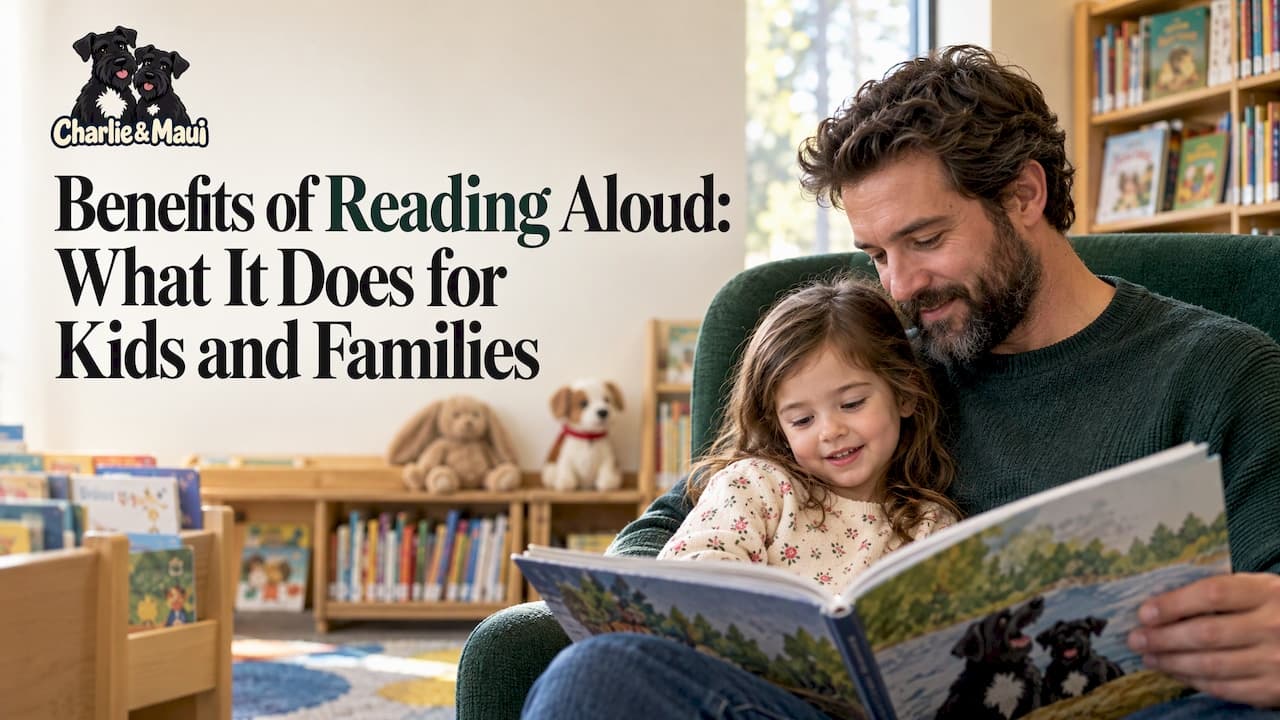
Reading aloud builds a child's vocabulary, listening skills, attention, and imagination. It also gives you a few quiet minutes of close connection every day. The American Academy of Pediatrics encourages parents to read aloud with babies and young children because the habit supports loving, nurturing relationships during a critical period of brain development. None of it requires special training. You need a book, a comfortable spot, and a few minutes.
This guide covers what reading aloud gives children, what it gives you, and how to get more from every session. It also covers how to use stories to talk about hard things like loss.
TL;DR
- Reading aloud grows vocabulary, listening, and attention, and it shows children what fluent, expressive reading sounds like.
- It strengthens the bond between you and your child, and it gives you a calm daily routine.
- Stories are a safe way to bring up big feelings such as worry, kindness, and grief.
- Short and regular beats long and rare. Ten or fifteen minutes a day is plenty.
- Pick books with characters your child cares about and questions you can stop and ask.
Table of Contents
- Why reading aloud works
- The benefits for children
- The benefits for parents and families
- Reading aloud as a way to talk about hard things
- How to read aloud well
- What reading aloud looks like at different ages
- Reading aloud in the classroom
- Our perspective
- Make it a habit: a simple four-week plan
- Where to find stories made for sharing
- Common obstacles, and easy fixes
- FAQ
- Sources
Why reading aloud works
When you read to a child, you do something the child cannot yet do alone. You turn written words into a living voice, with rhythm, emotion, and meaning. A five-year-old may not be able to decode a page of text, but they can follow a story far above their own reading level when someone else carries the words.
That gap is the whole point. Children hear richer language than they would in everyday talk, see how sentences are shaped, and learn that stories are worth the effort of learning to read. The pediatric guidance recommends starting shared reading at birth and continuing at least through kindergarten, which tells you how early the benefits begin and how long they are meant to last.
The benefits fall into a few groups. Some are about language and school, some about feelings and family, and some are about habits that stay with a child for years.
The benefits for children
Vocabulary and language
Books use words that rarely come up at the dinner table: curious, tumbled, mischievous, remember. A picture book with a good story might introduce several new words on a single page, each one attached to a scene the child can picture. Because the meaning is clear from the story, the word sticks.
You can help the process along:
- Pause on an interesting word and say it again in a different sentence.
- Ask, "What do you think that word means?" before you explain it.
- Bring the word back later in the day. "That puddle looks mischievous, doesn't it?"
Listening and attention
Listening to a story is a workout for a young mind. A child has to hold the beginning in memory while the middle unfolds, track who is doing what, and predict what comes next. Do that for ten minutes a night and the skill grows. It carries over into the classroom, where following a teacher's spoken directions and a group lesson depends on the same muscles.
Animal adventures are especially good for this age. A child who knows two dogs by name and personality will follow a plot with real effort, because they care what happens to them.
Early reading skills
Children who are read to learn how books work without being taught. They learn that we read left to right, that pages turn in order, that the marks on the page match the sounds you make. They hear rhyme, repetition, and rhythm, which prepare the ear for phonics. Reading aloud also shows what expressive reading sounds like: a pause at a comma, a lift at a question, a whisper for a secret.
For a child ages 4 to 9, who may be just learning to read or already reading on their own, this modeling matters at both ends. A beginner hears what the finished skill sounds like. A more confident reader gets to enjoy stories that are above their own independent level.
Imagination and curiosity
A story gives children a place to try on other lives. They ride along on a journey they could never take, meet characters unlike anyone in their neighborhood, and picture settings from the past. Curiosity grows when a child asks, "Why did that happen?" and has someone to ask. Reading aloud is one of the few times in a busy day when a child's questions are the main event.
Emotional understanding
Stories let children name feelings from a safe distance. When a character is nervous about a new place or sad about a friend, the child learns the words for those feelings and sees how someone else copes. That is easier than talking about their own worries cold. Reading together gives children a shared vocabulary for emotions, and it gives you an easy way into conversations that are hard to start head on.
The benefits for parents and families
Closeness
The most immediate benefit is the simplest. Sitting side by side with a book in your hands, a child leaning against you, is a few minutes of undivided attention. The pediatric recommendation itself frames reading aloud as a way to foster nurturing relationships, not only as a way to build skills. Children remember the warmth of the routine long after they forget the plots.
A calming routine
A story is a natural bridge between a busy day and bedtime. The same time, the same spot, and the same kind of quiet help a child settle down. Many families find that a predictable reading routine makes the end of the day smoother for everyone, parents included.
Shared memories
Families build their own language around books. A line from a favorite story becomes a joke at the table. A character's name becomes shorthand for "being brave" or "being kind." Older siblings, grandparents, and cousins can join in. These shared references are small, but they tie a family together.
Benefits for the reader too
The adult gets something out of it as well. Reading aloud slows you down. You notice the sentences, you do the voices, and you often rediscover why you loved books as a child. Grandparents who read to grandchildren, whether in person or over a video call, often say it is the part of the visit they treasure most.
Reading aloud as a way to talk about hard things
Some of the most valuable conversations with children begin with a story. A child who has lost a pet, a grandparent, or a friend may not know how to say what they feel. A character who goes through something similar gives them words, and gives you a gentle way to ask.
A few principles help:
- Let the story do the opening. Instead of asking, "How do you feel about what happened?" ask, "How do you think the dog felt when his friend was gone?"
- Leave room for silence. Children often answer a question several pages later, or at bedtime the next day.
- Share a memory of your own. When you say, "I remember when..." you show that remembering is allowed and good.
- Do not rush to fix the feeling. Sadness in a story can simply be sadness. Acknowledging it is often enough.
- Come back to it. Rereading the same book lets a child return to the hard part when they are ready.
If your child is struggling with a significant loss or seems distressed for weeks, talk with your pediatrician or a child counselor. A story is a good companion for those conversations, but it does not replace professional help when a child needs it.
How to read aloud well
You do not need to be a performer. A few small habits make the time more valuable.
Choose the right book
Look for characters a child can love, a plot that moves, and language with a little music in it. Illustrations that carry part of the story give children something to talk about. For younger listeners, our guide to books to read aloud to 5 year olds goes through how to pick ones that hold their attention.
Set a routine
Pick a time that works and protect it. Ten to fifteen minutes is enough. Consistency matters more than length. A short story every night does more than a long session once a week.
Use your voice
Change pitch for different characters. Slow down at tense moments. Whisper where the story whispers. You do not need an accent or a performance, just a little variety.
Stop and talk
Pause now and then, especially at turning points:
- "What do you think will happen next?"
- "Why did she do that?"
- "Has anything like this ever happened to you?"
Two or three good questions per sitting are enough. Do not turn a story into a quiz.
Let the child lead
Let them turn the pages, point at pictures, or choose tonight's book. A child who feels ownership over the story stays engaged. When they ask for the same book for the twentieth night, say yes. Repetition helps children notice new details and feel secure.
Keep screens out of the spot
Put the phone in another room. Your undivided attention is part of the benefit.
What reading aloud looks like at different ages
| Age | What it can look like | What to focus on |
|---|---|---|
| 4 | Picture books with strong illustrations and repeating phrases | Naming feelings, new words, predicting what comes next |
| 5 to 6 | Short stories with a simple plot and a clear character arc | Questions about why characters act as they do, retelling in the child's words |
| 7 to 9 | Longer stories, chapter-by-chapter, with richer themes | Discussing values, making connections to family history, letting the child read a page back to you |
Even when a child can read independently, reading aloud still has value. Children can understand and enjoy stories that are more complex than the ones they can read alone, and the shared time keeps books associated with warmth rather than homework.
Reading aloud in the classroom
Teachers use read-alouds for the same reasons parents do. A shared story gives a whole class a common reference point, introduces new words in context, and opens discussion in a way that feels low-pressure. Educators looking for stories to support lessons on friendship, empathy, or coping with loss can use a read-aloud as the starting point and follow it with a short discussion or a drawing activity.
Some tips for the classroom:
- Preview the book so you can plan where to pause.
- Choose two or three discussion questions ahead of time.
- Invite quiet students to respond through drawing or a partner chat.
- Revisit the story later in the week to deepen understanding.
Our perspective
We write our books to be read aloud, and that shapes everything about them. A story meant for a grown-up and a child to share needs more than a plot. It needs places to stop, things to wonder about, and feelings worth naming.
That is why each Charlie and Maui book comes with illustrated stories, conversation questions, memory activities, and author notes, made for ages 4 to 9 to read with adults. The two dogs go on adventures that touch on curiosity, kindness, and friendship. Some of the stories take on harder ground, like a dog coping with the death of a friend, and the questions at the back give families a gentle way to talk about it.
I'm a U.S. Navy veteran, and my own experiences and family are behind these stories. I know how much a child and a parent can say to each other through a shared book when the words are hard to find directly. Dogs make that easier. Children already trust them, and they will follow a dog through feelings they would not yet bring up themselves.
So when we talk about the benefits of reading aloud, we mean more than vocabulary, as important as that is. We mean the memories you make, the questions your child asks at the end of a chapter, and the way a story can start a conversation your family needed to have.
Jake
Make it a habit: a simple four-week plan
If reading aloud is not part of your routine yet, start small and build.

Week 1: Anchor it. Choose one time of day and read for ten minutes. Do not worry about the book. Just show up.
Week 2: Add questions. Pick one place in each story to pause and ask what your child thinks will happen or how a character feels.
Week 3: Add a memory. After a story, share a related memory of your own, or ask your child to share one. Draw it together if they prefer.
Week 4: Let them lead. Let your child choose the book, turn the pages, and do a voice. Invite a sibling or grandparent to join.
By the end of the month, the habit should feel natural, and your child will likely be reminding you when it's time.
Where to find stories made for sharing
If you want books designed for reading with an adult, our Charlie and Maui stories follow two dogs through adventures about curiosity, kindness, and friendship. Each book includes illustrated stories, conversation questions, memory activities, and author notes for ages 4 to 9 to read with adults.
You can see the whole series on our Charlie and Maui books page, and the books are available in print and digital formats through online retailers and the author's website.

If you are not sure where to start, our guide to read-aloud books for 5 year olds explains what to look for in a story.
Common obstacles, and easy fixes
"My child won't sit still." Let them move. Many children listen better while drawing, building with blocks, or lying on the floor. Keep the session short and end while they still want more.
"We don't have time." Ten minutes counts. Read at breakfast, in the car before school, or while dinner finishes. A short, steady habit beats an ambitious plan you drop.
"I don't like doing voices." Skip them. Your natural voice is the one your child most wants to hear. Add a little expression, and that is plenty.
"My child can already read." Keep going. Reading aloud lets you share stories above their independent level, and it keeps reading a shared pleasure.
"My child wants the same book every night." That is a good sign. Familiar stories give children the confidence to notice details, predict events, and ask deeper questions.

FAQ
How long should I read aloud each day?
Ten to fifteen minutes is a good target for most families, and the key is doing it regularly. A short story every night is better than a long one now and then. On busy days, even one picture book keeps the habit alive.
At what age should I start reading aloud?
The American Academy of Pediatrics recommends beginning shared reading at birth and continuing at least through kindergarten. Many families keep going well past that, into the elementary years, because the benefits of closeness and conversation continue.
Should I keep reading aloud once my child can read alone?
Yes. Children can follow and enjoy more complex stories than they can read themselves, and the shared time keeps reading warm and social. You can also take turns, with your child reading a page and you reading the next.
Can reading aloud help a child cope with loss?
It can help open the conversation. A story about a character who experiences a similar loss gives a child words and a safe distance for talking about their feelings. If your child seems very distressed or the sadness lasts, speak with your pediatrician or a child counselor.
What makes a good book to read aloud?
Look for characters your child connects with, a story that moves, language with rhythm, and illustrations that invite talk. Books that include conversation questions or activities make it easier to turn a story into a discussion.