
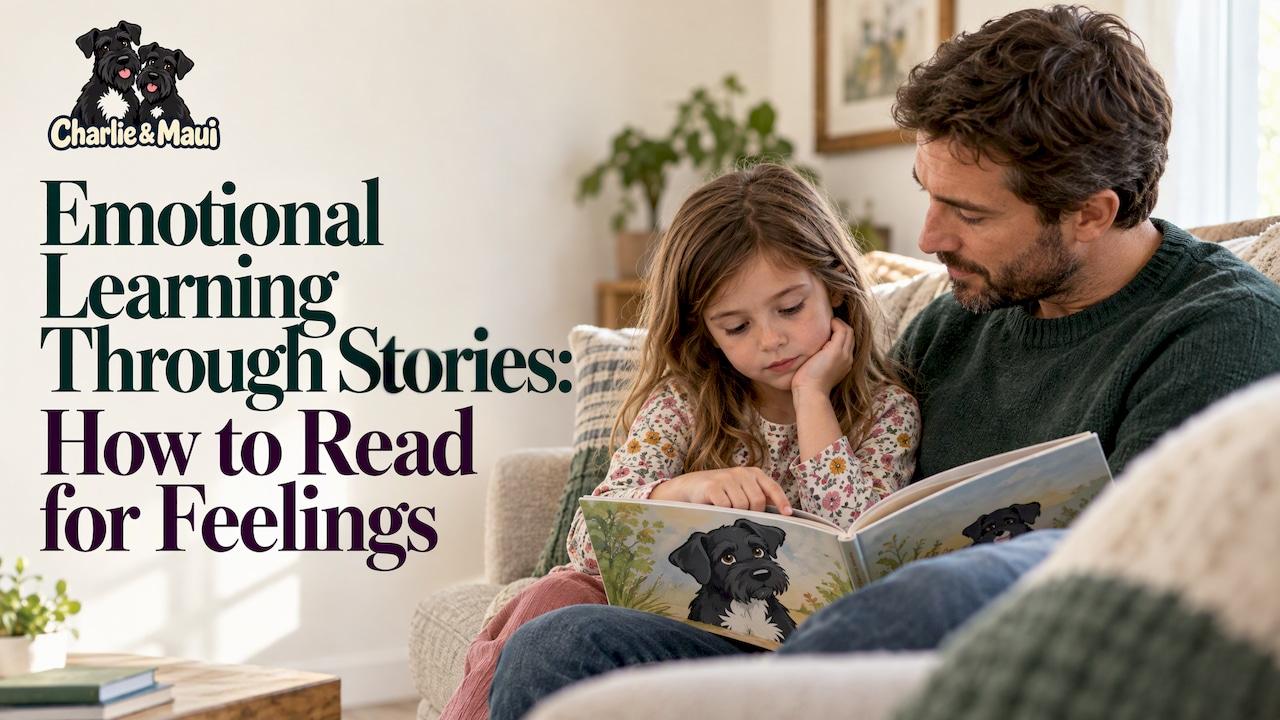
Children learn about feelings best when they can watch someone else have them. A story gives them that: a character who is nervous, left out, proud or grieving, and an adult beside them who can pause and ask, "How do you think she feels?" That pause is where emotional learning happens. This guide explains why it works, what the research says, and how to turn any read-aloud into a short conversation about feelings. It also shows how our Charlie and Maui books are built for exactly this kind of shared reading.
TL;DR
- Stories let children rehearse feelings safely: they see a character's emotions from the outside before they have to manage their own.
- The reading matters less than the talking. Pausing to ask about a character's feelings is what builds emotion words, empathy and perspective-taking.
- Choose stories where characters wait, worry, miss someone or feel disappointed. A neat ending is not required.
- A few minutes of open-ended questions after a read-aloud is enough. Consistency beats length.
- Our Charlie and Maui books pair illustrated dog adventures with conversation questions, memory activities and author notes for ages 4 to 9.
Table of Contents
- Why stories work for emotional learning
- What children actually learn from emotional stories
- What the research shows
- A simple routine for reading about feelings
- Choosing stories that help with hard feelings
- Friendship, kindness and loss through two dogs
- What this looks like in a classroom
- Our perspective
- Bring Charlie and Maui into your read-aloud routine
- FAQ
- Sources
Why stories work for emotional learning
A feeling is hard to teach in the abstract. "Frustration" means little to a five-year-old in the middle of a meltdown. In a story, the same feeling arrives with a face, a situation and a reason. The child can look at it without being swamped by it.
Researchers describe this as a kind of distance. One paper on storytelling and social wellness, published through ERIC (the U.S. Department of Education's research library), argues that stories deliver morals and ethical lessons indirectly, which lets children see situations objectively instead of defensively. A lecture about sharing feels like a correction. A story about a dog who will not share a ball feels like an adventure, and the child draws the conclusion alone.
There is also a brain-based reason. BBC Teach reports that brain activity while reading fiction resembles living through the situation, which helps children work out how to solve problems they have not yet faced. A story works as practice, and the stakes stay low.

What children actually learn from emotional stories
"Emotional learning" is a broad phrase. In practice, stories build four separate skills.
Naming feelings
Children cannot talk about what they cannot name. Texas A&M's education faculty notes that storytelling helps children understand and express emotions, along with language, literacy and confidence. The U.S. Head Start program makes a similar point: reading developmentally appropriate books can help young children define and communicate difficult emotions.
A child who has heard "Maui felt nervous and a little left out" has a phrase to borrow next time the feeling shows up.
Reading other people's feelings
According to UConn's Neag School of Education, reading helps children pick up cues about how characters might feel and imagine what others are experiencing, which supports empathy, self-regulation and perspective-taking. Perspective-taking simply means understanding that another person sees and feels things differently than you do.
A 2019 paper on children's storybooks and empathy adds a timing detail: children typically acquire the skill of mentalizing between ages three and four. Mentalizing is the ability to understand that other people have their own thoughts and feelings. That is why picture books fit the preschool and early school years so well.
Managing big feelings
BookTrust, a children's reading charity in the UK, explains that story reading supports emotional regulation through adult co-regulation, emotion labeling and symbolic rehearsal of emotional challenges. Co-regulation means a calm adult helps a child settle, and a cozy read-aloud is a natural setting for it. Rehearsal means the child lives through a hard moment on the page before facing one in life.
Coping with change and loss
Stories about waiting, fear, disappointment and goodbye give children a safe place to practice coping. BookTrust notes that when characters face tough emotions, children can practice cognitive flexibility and emotional coping, which is the ability to shift how you think about a problem.
What the research shows
The evidence goes beyond general claims that reading is good for kids. Several studies tested story-based activities directly.
| Study | Who | What it found |
|---|---|---|
| Frontiers in Psychology, 2014 | Second and third graders, Germany | A literature-based program significantly improved emotional vocabulary, explicit emotional knowledge and recognition of masked feelings |
| Preschool study, 2015 | Preschoolers, United States | Narrative- and play-based activities were associated with better self-regulation and less disruption during play |
| Conceptual paper, 2019 | Parents and young children | Mothers' talk about thoughts and feelings during shared reading has a positive impact on children's theory of mind |
"Theory of mind" is the understanding that other people have beliefs and feelings different from your own. BBC Teach reports that scientists have found children who are read fiction regularly find it easier to understand others and show more empathy.
The common thread is conversation. BookTrust's guide notes that neuroimaging studies show shared reading activates brain regions linked to language, self-regulation and cognitive control when it is emotionally rich and responsive. Responsive means the adult follows the child's reactions instead of simply reading the words through.
A simple routine for reading about feelings
You do not need a curriculum. You need a story with feelings in it and a few habits. Here is a routine that draws on the guidance from Texas A&M, Harvard and BookTrust.
- Pick a regular time. Bedtime works for many families. Classrooms often use a story circle after lunch. A routine makes the conversation feel normal rather than like a quiz. Our guide to the benefits of reading aloud covers how to build the habit.
- Read the whole story once without interrupting if the child is new to it. Let them enjoy the plot first.
- On the second read, pause at emotional moments. Texas A&M suggests stopping to ask how a character feels and then asking how those feelings might change if the situation changed. "What if Charlie had found his friend right away?"
- Ask open-ended questions. Skip yes-or-no questions. Try "What do you think she is feeling?" and "What makes you say that?" BookTrust describes dialogic reading, which means turn-taking and child-led discussion, as a way to improve the quality of adult scaffolding. Scaffolding is the adult support that helps a child reach a little further than they could alone.
- Share your own view. Harvard's Making Caring Common project advises adults to ask about characters' feelings and model the process by sharing their own interpretations of different points of view. Say "I think he looks worried, because..." and let the child agree or disagree.
- Connect to real life lightly. "Have you ever felt like that?" works best when the child offers the answer. Do not push if they do not want to.
- Close with something small. A drawing, a memory or a quiet minute. The goal is a calm landing, not a lesson.
Five to ten minutes is plenty. If your child resists, our guide on reading with reluctant readers has ideas for making it feel like play. For more ways to keep the habit going, see these family reading activities.
Choosing stories that help with hard feelings
Not every book carries the same emotional weight. A few things to look for:
- Characters who feel something real. BookTrust suggests choosing age-appropriate stories where characters wait, plan, or face fear or disappointment. Those moments give you something to talk about.
- Endings that do not tie everything up. The same guide notes children can explore real-life challenges safely even without a neat, happy ending.
- A reading level that matches the child. Picture books suit ages 4 and 5, and chapter books with shared reading suit the older end of the range. Our lists of read-aloud books for 4-year-olds, books for 5-year-olds and books for 9-year-olds can help, and the practical guide to choosing books for children covers the basics.
- Built-in support for the conversation. The National Association for the Education of Young Children (NAEYC) recommends giving families simple discussion guides with open-ended questions and follow-up activities, so picture books become tools for emotional conversations. Books that include their own prompts take the guesswork out of it.
Friendship, kindness and loss through two dogs
Animal characters are a good vehicle for emotion. A dog can be scared, jealous or sad without the child feeling that the story is about them. That small distance makes hard topics easier to approach.
The Charlie and Maui books follow two dogs on adventures that bring in curiosity, kindness, friendship and family connections. Each book includes an illustrated story, conversation questions, memory activities and author notes, written for ages 4 to 9 to read with an adult. The questions are there so the pause-and-ask routine above has a starting point on every page spread you want it.
One story follows a dog coping with the death of a friend. Loss is among the hardest feelings to introduce, and a story gives a family a way in without anyone having to start from nothing. If you are navigating this now, these guides may help: helping a child grieve, how children understand death at every age and remembering a pet with kids. If a child's grief seems to overwhelm daily life for a long stretch, talk with your pediatrician or a child mental health professional.

What this looks like in a classroom
Educators have an advantage: a group of children hears the same story and offers different readings of it. That variety is itself a lesson in perspective-taking.
- Use a story circle. Read, pause at one or two feeling moments, and let children answer in turn.
- Send the conversation home. NAEYC suggests teachers can help families with a lending library, simple discussion guides, and modeling strategies at family literacy events. Questions that travel home carry the learning across the school day and the evening.
- Pair reading with a small activity. Drawing a character's feeling or writing a sentence about a memory gives quieter children another way to take part.
- Revisit the same book. Rereading lets children notice new feelings and deeper reasons each time.
Books that ship with questions, memory activities and author notes suit this work, since the discussion scaffolding is already on the page.
Our perspective
We write stories for the moment after the last page, when a child looks up and says something unexpected.
I'm a U.S. Navy veteran, and my family and my own experiences shaped these books. Moving, missing people and learning to carry memories are part of real life, and children feel them long before they have words for them. Charlie and Maui let us talk about those feelings through two dogs a child can love.
That is why every book includes conversation questions, memory activities and author notes. The story opens the door, and the questions help a parent, grandparent or teacher walk through it together with a child. We believe a book works best when it gives families something to do and say, and we built ours around that idea.
Jake
Bring Charlie and Maui into your read-aloud routine
If you want a story that comes with its conversation built in, the Charlie and Maui books are written for children ages 4 to 9 to read with an adult. Each includes an illustrated story, conversation questions, memory activities and author notes, with themes that include friendship, kindness, curiosity, family connections and coping with loss. You can see the full line, in print and digital, on the Charlie and Maui books page.

Start with whichever theme fits your family right now, read it twice, and let the questions lead.
FAQ
What are the benefits of emotional storytelling?
Stories help children learn to name and express feelings, understand what others feel, and build language and confidence, according to Texas A&M's education faculty. They also give children a safe way to rehearse hard moments. The benefits grow when an adult talks through the story with the child.
At what age can children start learning emotions from stories?
Children typically develop the skill of mentalizing, or understanding that others have their own thoughts and feelings, between ages three and four. Picture books with simple feelings work well from preschool on. Children ages 4 to 9 enjoy deeper discussion as their vocabulary grows.
How do I talk about feelings during a read-aloud?
Pause at an emotional moment and ask an open-ended question such as "How do you think the character feels?" Share your own view too, as Harvard's Making Caring Common project recommends. Keep it short and follow the child's lead.
Do the stories need happy endings?
No. BookTrust notes that children can explore real-life challenges safely through stories even without a neat, happy ending. What matters is that characters face real feelings and that an adult is there to talk about them.
Sources
- Storytelling to Understand Emotions, Texas A&M University
- Why is storytelling important to children? BBC Teach
- How Fiction Affects Children's Social-Emotional Learning, UConn
- Tell Me a Story Series, Head Start
- How Could Children's Storybooks Promote Empathy? (2019)
- Connecting Storytelling and Social Wellness, ERIC
- Partnering with Families to Support Emotional Learning, NAEYC
- How to Use Stories to Help Kids Develop Empathy, Making Caring Common, Harvard
- Reading, executive function and self-regulation, BookTrust
- READING and FEELING, Frontiers in Psychology (2014)
- Using a narrative- and play-based activity to promote self-regulation (2015)