
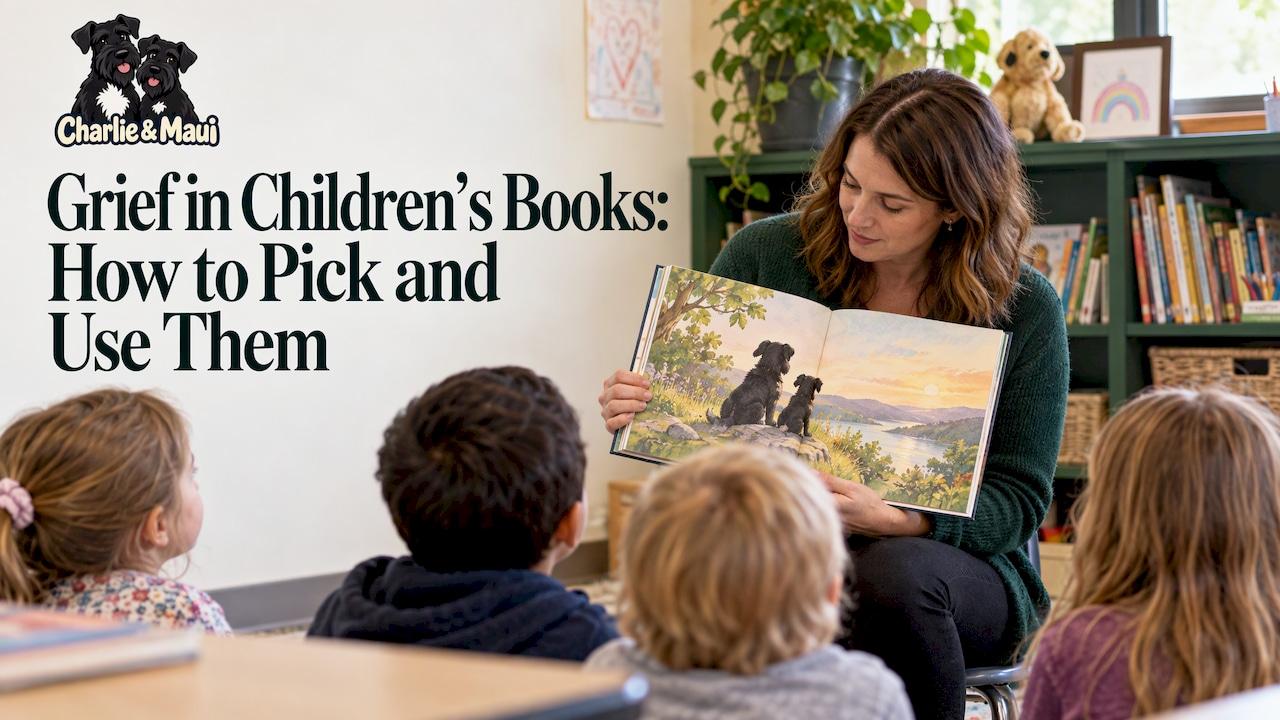
A good children's book about grief gives a child words and pictures for a feeling they cannot yet explain, and gives you a way to start talking. The best ones are honest about death, gentle in tone, and built to be read with an adult. Our Charlie and Maui books use two dogs to explore friendship, memory and coping with loss, with conversation questions and memory activities included for families and classrooms.
TL;DR
- Choose a book that says plainly that someone died, in language that fits your child's age, and read it yourself first.
- Use the story as a prompt: ask simple open questions, listen, and avoid "at least" comfort and euphemisms.
- Match the book to the loss: a friend, a pet, a grandparent or a classmate each raise different questions.
- Books with built-in questions and memory activities turn one reading into a longer conversation.
- Our Charlie and Maui books are written for ages 4 to 9 to be read together with an adult.
Table of Contents
- Why a story helps when a child is grieving
- What to look for in a grief book
- Read it yourself first
- How to read it together
- When the loss is a friend
- When the loss is a pet
- A worked example: one story, three conversations
- Using grief books in a classroom or group
- Our view on grief in children's books
- Charlie and Maui: stories to read together
- Choosing well: a short checklist
- FAQ
- Sources
Why a story helps when a child is grieving
Children often cannot say what they feel, but they can point at a character who feels it. A story puts distance between the child and the pain. The child can watch a character cry, miss someone and slowly feel better, without being asked to talk about themselves.
That matters because adults often worry that bringing up death will upset a child. Pediatric guidance published in 2024 in Pediatrics makes the opposite point: it is the death itself, not asking about it, that causes distress, and inviting a child to share feelings lets them express sadness without creating it.
The field of grief-related picture books has also grown. The Association of Children's Museums notes that children's bereavement media has expanded substantially in the last decade, including new work for ages 0 to 8. That is good news, and it also means you need a way to choose.
What to look for in a grief book
Every child and every loss is different, so start with a few plain criteria rather than a title.
Honest language
Young children take words literally. Author and grief expert David Schonfeld explains on NAEYC's site that with younger children it is important to use the words "dead" and "died", because indirect phrases can confuse or frighten. His example: "eternal sleep" could make a child afraid to sleep. Mayo Clinic gives the same advice for preschoolers: use concrete language that includes "death" and "died" and avoid phrases like "gone to sleep."
When you skim a book, check that it does not hide behind those phrases. A story can be soft and warm and still be clear.
The right age and reading level
Book lists are usually grouped by age. NAEYC, for example, sorts its recommended books about death into groups for ages 0 to 3, 3 to 5 and 6 to 8. The youngest children need very short, simple, truthful explanations. ZERO TO THREE suggests wording such as "Dying means that their body stopped working" for children under 3.
For children from about 4 to 9, a longer story with characters, a small adventure and room for questions works well. That is the range our books are written for.
A fit with the loss your child is facing
A child who lost a grandparent, a child who lost a friend and a child whose dog died are asking different questions. Look for a story close to the situation, but broad enough that your child can see themselves in it. NAEYC describes a teacher who chose a book for a four-year-old precisely because it avoided specific details about why a person was absent, so the child could bring their own experience to it.
If your child has particular communication needs, the guidance is to individualize. A tip sheet from Vanderbilt Kennedy Center's TRIAD program says that grief stories for autistic youth should fit the specific situation, with developmentally and language-appropriate information and representative pictures.
Something for the adult to work with
A picture book is a starting point, not the whole conversation. The most useful books include questions to ask, or something to do afterward. Without them, many parents finish the last page, feel the quiet, and do not know what to say next.
Read it yourself first
The New York Public Library's advice for grief books is simple: read the book on your own first so you are comfortable with the emotional content before you read it aloud. This is the step most adults skip, and it is the one that most changes the reading.
If you are choked up on page six when your child is watching, that is not a failure. But you will answer questions better, and pause in the right places, if you have already met the ending. It also lets you decide whether this is the right moment for this book.
How to read it together
There is no script, but a few habits help.
- Pick a quiet time. Not bedtime on a rushed night. Give the book room, and give yourself room to stop.
- Read slowly and let the pictures work. Pause when a character is sad. Children often look at the illustration for a long time.
- Ask simple, open questions. "How do you think the dog feels?" works better than "Are you sad?" NAEYC's guidance recommends inviting conversation with simple open-ended questions, then listening and observing rather than filling the silence.
- Answer honestly and briefly. If you do not know, say so.
- Let the child lead. Some children want to talk. Some want to read the same page five times. Both are normal.
- Come back to it. Grief does not finish in one sitting. A second and third reading often bring different questions.
What to avoid saying
The 2024 Pediatrics guidance is specific about phrases that backfire. It advises against "at least" statements, telling children to hide their emotions, "you must" statements about how they should feel, and comparisons that move the focus away from the child. "At least you have other friends" feels kind to the adult and lands as dismissal for the child.
A book helps here because the story can say the hard thing for you. If the character is allowed to be sad for a while, your child learns that they are allowed too.
For more on what to say and do, see our guide on helping a child grieve, and our overview of how children understand death at every age.
When the loss is a friend
Losing a friend, whether a classmate or a companion, is a different kind of grief from losing an older relative. Children expect friends to be there tomorrow. A friend's death can feel unfair and confusing, and children may worry about who else might go.
Stories about friendship and loss help because they treat the friend as a real presence in the child's life, not a lesser loss. They give children permission to miss someone their own age, or someone who shared their daily play. In a classroom, a shared story also shows every child that they are not alone. NAEYC's article on children's books and loss recommends that teachers create safe spaces for dialogue and use storytelling to help children process grief and find comfort in knowing they are not the only one.
When the loss is a pet
For many children, a pet is the first death they experience. It is real grief, and it deserves a real response. A dog or cat is a daily companion, and the loss shows up in the quiet house, the empty bowl and the missing greeting at the door.

A story about a dog who loses a friend is an easy way in, because the child can talk about the animal before talking about their own heart. After reading, many families like to do something to remember the pet: draw, plant, write, or make a keepsake. If you want ideas that go beyond the story, these pet remembrance ideas cover personal ways to keep a pet's memory close. Our own guide to remembering a pet with kids is written for the conversation that comes after the last page.
A worked example: one story, three conversations
Suppose your six-year-old has just lost a dog that lived in the house their whole life. Here is how a single reading can unfold.
First sitting. You read the story through once, slowly. You stop at one moment when a character is sad and ask, "What do you think he is feeling right now?" Your child says, "Lonely." You say, "Yes. Lonely is a real feeling when you miss someone." You do not fix it.
Second sitting, a few days later. Your child asks for the book again and points to a picture. This time the question is about the dog: "Does it hurt when they die?" You answer with a short, true sentence suited to their age, using the word "died," and you ask what they have been wondering.
Third sitting, a week or two later. You move from the book to a memory. "What was your favorite thing to do with him?" Your child tells you. You write it down together.
None of this required special training. It required a story that opened the door, and an adult who was willing to listen.

Using grief books in a classroom or group
Educators have a slightly different job. You may have a whole class, with different families and different experiences of loss. A few principles help.
- Choose stories that are broad. A story about a character who lost a friend works for a child whose grandparent died, because the feeling is shared even if the circumstances are not.
- Prepare the room. Tell families in advance that you will read a story about loss, so no child is surprised at home or at school.
- Offer more than one way to respond. Some children will talk, some will draw, and some will say nothing at all. Each is a valid response.
- Watch and follow up. The American Academy of Pediatrics notes that bereavement can have a long-term impact on children's psychological adjustment and academic achievement. If a child seems stuck in distress that does not ease, talk with the family and the school counselor or the child's pediatrician.
Books with conversation questions built in save preparation time, because the prompts are already there when the room goes quiet.
Our view on grief in children's books
We write about loss because children meet it, whether or not we are ready. In our books, two dogs, Charlie and Maui, go on adventures together. The stories are about curiosity, kindness and friendship, and one of them follows a dog coping with the death of a friend.
We write from our own experience as a U.S. Navy veteran and a family man. That shapes how we handle hard feelings: plainly, with care, and with a belief that children can handle honest stories when an adult is beside them.
That is why every book includes illustrated stories, conversation questions, memory activities and author notes. A story should not end when you close the cover. It should give a parent, a grandparent or a teacher a way to ask, "What do you remember? What do you miss? What would you like to tell them?"
Animal characters make that easier. A child who cannot yet say "I am sad" can say "the dog is sad", and from there the conversation has begun. We wrote these books for ages 4 to 9, to be read together, because grief is easier to carry when someone is holding the other end.
Jake
Charlie and Maui: stories to read together
Our Charlie and Maui books follow two dogs through adventures about friendship, kindness and curiosity, and through harder moments of loss and remembrance. Each book has an illustrated story, conversation questions, memory activities and author notes, so a parent or educator has something to say after the last page. They are written for children ages 4 to 9 to read with an adult, and they are available in print and digital editions.

You can see the whole line on our Charlie and Maui books page.
Choosing well: a short checklist
Before you buy or borrow any grief book, run through these questions:
- Does it use clear words about death, or does it hide behind euphemisms?
- Does the age range match your child, and is the text a length they can sit through?
- Is the loss close enough to your child's situation to feel relevant, but open enough for them to see themselves?
- Have you read it yourself, start to finish?
- Does it give you questions or activities, so the conversation can continue?
For wider advice on selecting books, see our practical guide to choosing books for children. If your child is four, our list of read-aloud books for 4-year-olds and our post on family reading activities offer more ways to make reading together part of the week.
FAQ
What age is right for a children's book about grief?
There is no minimum age, but the book has to match the child. Resource lists such as NAEYC's start at ages 0 to 3 with very simple texts. For ages 4 to 9, a story with characters and a gentle plot, read with an adult, usually works well.
Should I use the word "died" with a young child?
Yes. Both Mayo Clinic and NAEYC's author guidance advise using "dead" and "died" with young children, because phrases like "gone to sleep" can confuse them or cause fears. Say it simply and kindly, then listen to what your child asks next.
Will a book about death make my child sadder?
The 2024 Pediatrics guidance says the death, not the asking, causes distress, and that inviting children to share feelings lets them express sadness without creating it. Read the book yourself first so you can stay steady, and go at your child's pace.
Can a story about animals help with the loss of a person?
Often, yes. Animal characters give a child a safe way to talk about feelings before talking about their own. The story does not need to match the loss exactly. It needs to be honest about sadness and about remembering someone.
What if my child's grief seems to get worse over time?
Talk with your child's pediatrician or a school counselor. Bereavement can have a long-term impact on children's adjustment, as the American Academy of Pediatrics notes, and a professional can help you decide what support your child needs.
Sources
- Helping Young Children Grieve and Understand Death, NAEYC
- Supporting the Grieving Child and Family, Pediatrics (2024)
- Supporting the Grieving Child and Family, American Academy of Pediatrics
- Helping Children Grieve: For Parents of Preschoolers, Mayo Clinic
- Helping Toddlers Cope with Grief and Death, ZERO TO THREE
- Resources on Death for Young Children, Families, and Educators, NAEYC
- The Healing Power of Children's Books for Children Experiencing Loss, NAEYC
- Children's Books about Death, Loss, and Grieving, New York Public Library
- Book and Movie Recommendations, Association of Children's Museums
- Supporting Autistic Students Experiencing Grief and Loss, Vanderbilt Kennedy Center TRIAD tip sheet