
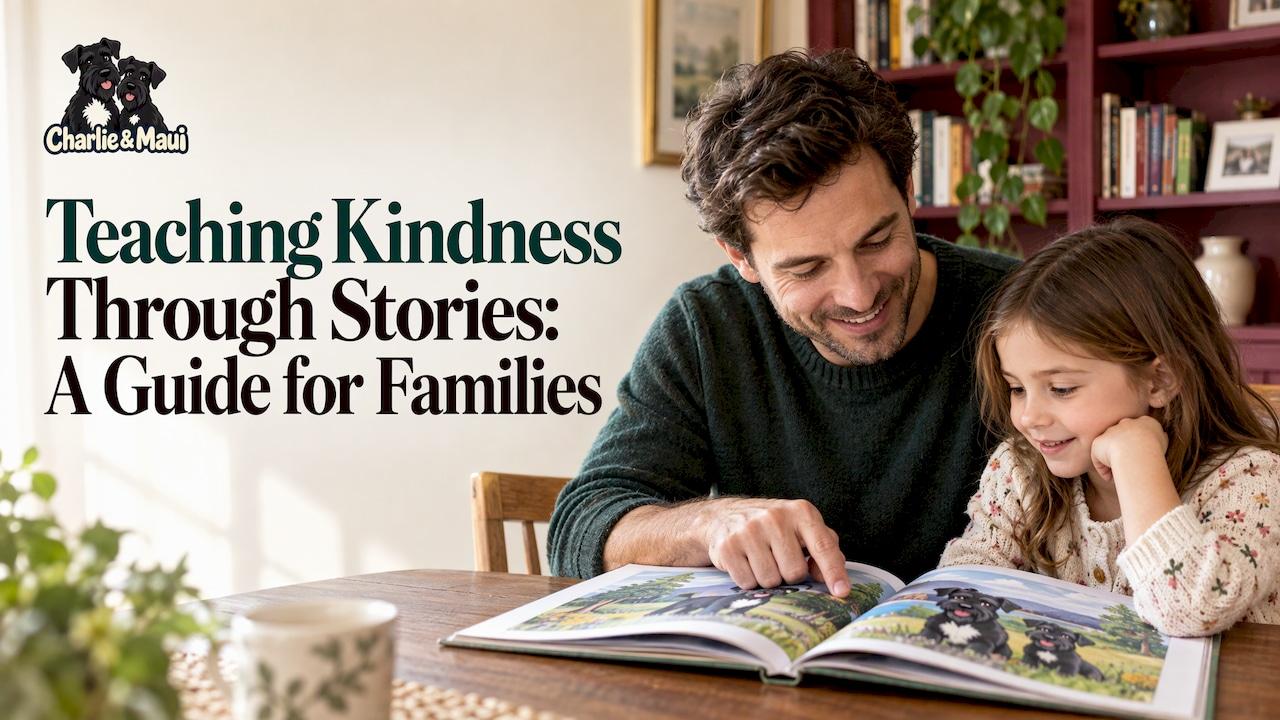
Stories teach kindness best when a child gets to step inside a character's feelings and then talk about it with a trusted adult. The book starts the conversation. The questions you ask, the pauses you leave and the small activity afterward turn a nice story into a habit. Our Charlie and Maui books are written for exactly this kind of shared reading: two dogs, an adventure, and conversation questions, memory activities and author notes built in for children ages 4 to 9 to read with an adult. You can see the full line on the Charlie and Maui books page.
TL;DR
- Stories let children try on another person's point of view, consider what a character could do and see how actions affect feelings. That is the raw material of kindness.
- Pick a story with a clear emotional thread, characters who treat each other in different ways and room for talk afterward.
- Ask two or three simple questions, not ten. Which character are you most like? How did that character feel? What would you do?
- Follow the reading with one small act: a role play, a note of thanks, a drawing, a kindness you try this week.
- Animal characters make big feelings easier to discuss, including hard ones like loss.
Table of Contents
- Why stories work for teaching kindness
- What to look for in a story about kindness
- How to read a story so kindness sticks
- Questions that open the conversation
- Activities that carry kindness into the week
- Why animal adventures help children talk about caring
- A worked example: one story, ten minutes
- For classrooms and groups
- Our perspective
- Start with Charlie and Maui
- FAQ
- Sources
Why stories work for teaching kindness
Telling a child to be kind is a rule. Showing them a character who is lonely, and letting them feel that loneliness for a page or two, is an experience. That difference is why teachers and researchers keep returning to literature.
A 2024 article on using children's literature to foster kindness explains that stories let elementary students consider perspectives, identify possible actions and anticipate outcomes. When a child talks through how one character's actions changed another character's feelings, they are learning cause and effect in human terms: if I do this, that person feels that. They also see that the character could have chosen differently, which is where the idea of choosing kindness begins.
Harvard's Making Caring Common project describes stories as windows, mirrors and sliding doors. A window shows a child a life unlike theirs. A mirror shows them their own. A sliding door lets them step into someone else's experience. A good kindness story does at least one of these, and the best do all three.
None of this requires special training. It requires a story worth discussing and an adult willing to ask a few questions and listen to the answers.
What to look for in a story about kindness
Not every book that mentions being nice teaches kindness. A story that simply announces a moral on the last page gives a child something to repeat, not something to feel. Here is what tends to matter.
Characters who make real choices
The most useful stories show characters in different situations behaving in different ways toward others. Reading Rockets, a national literacy initiative, suggests choosing stories showing how characters in different situations behave toward others for kindergarteners. For preschoolers it recommends classic stories with universal themes such as friendship and generosity, and for third graders, books that tackle tough topics and lead to discussion. In other words, the right book moves up with the child: simple and warm at four, more layered by eight or nine.
Emotion that a child can name
The Institute of Education Sciences, in a January 2025 planning guide from its REL West lab, offers questions for judging a storybook. One asks whether the story cultivates emotional intelligence: promoting empathy, modeling kindness, compassion or gratitude, and validating emotions. The same guide asks whether the story is engaging, inclusive, language rich and well illustrated. For a parent, the practical version is simple. Can your child point to a page and say how a character feels? If yes, you have something to talk about.
Room for the adult
A story with a built-in way to talk is easier to use than one that leaves you improvising at bedtime. That is why each Charlie and Maui book includes conversation questions, memory activities and author notes alongside the illustrated story. If you are still deciding what suits your child's age and temperament, our practical guide to choosing books for children walks through it, and our list of read-aloud books for 4-year-olds and for 9-year-olds covers the two ends of the age range these stories serve.
How to read a story so kindness sticks
The research suggests a rhythm that works at home as well as in a classroom. The 2024 article mentioned above describes an instruction framework called IDEA: Identify the kindness practice, Develop think-alouds, Explicitly explain and model it, and Apply it through role play, discussion and collaborative tasks. Here is that idea translated for a living room.
- Name what you are looking for before you start. Keep it small: "Let's notice how Charlie treats his friend in this story." A child who knows what to watch for reads more actively.
- Think out loud. Stop at a key page and say what you are wondering. "Hmm, Maui looks worried here. I wonder what he's thinking." Children copy how adults reason about feelings.
- Say it plainly, then show it. After the story, connect the character's choice to a simple idea: kindness is noticing someone needs help and doing something about it. Then model it with a small example from your own day.
- Apply it. Act it out, draw it, write about it or plan one kind thing for tomorrow. This is the step most readers skip, and it is where the lesson leaves the page.
Harvard's guidance adds that adults can model their own interpretations of a character's feelings and show that people can see the same moment differently. That helps a child learn that other people's views are real, even when they differ from their own.
Questions that open the conversation
The Greater Good in Education program at UC Berkeley organizes discussion questions into three groups: identifying with characters, naming emotions and understanding motivations. Its guide notes that students tend to feel more empathy when they are prompted to put themselves in someone else's shoes. Here are questions in that spirit, adapted for a child ages 4 to 9.
Identifying with a character
- Which character are you most like in this story? Why?
- Have you ever felt the way this character felt?
Naming feelings
- How do you think this character feels right now? How can you tell from the picture?
- What kinds of things made you happy or sad today? (Harvard's family guide suggests making simple, specific feeling questions a daily habit, not only a story-time one.)
Understanding why
- Why do you think the character did that?
- What would you have done in that spot?
- How did that kindness change the day for the other character?
Keep it light
You do not have to ask all of these. A long-running family guide on talking about stories notes that one or two questions is all some children will tolerate, and that a single comment from a parent who takes an idea seriously is often enough to start a child thinking. If your child answers one question and then wants the next page, that is a good reading session. Come back to the question tomorrow.
Activities that carry kindness into the week
A story lands harder when children do something with it. Classroom lesson plans offer plenty of ideas that adapt easily to a kitchen table.
Share a moment, then set a goal
A university lesson on sharing, built around a picture book, follows the story with questions such as when have you shared with someone, and how did it feel. For grades 3 to 6 it adds a kindness poem or rap: brainstorm kind acts, write a group poem, and set a goal for showing more kindness that week. A family can do the same with a short rhyme about what kindness looks like in your house, stuck to the refrigerator.

Act it out and say thank you
UC Berkeley's Greater Good in Education has a lesson called Caring Intentions. After a story about a character who receives acts of kindness, children answer how the character felt, act out skits thanking her, then draw someone who cares for them and write a note of gratitude. At home, the note can go to a grandparent, a neighbor or the person who drives the school bus.
Rehearse the better choice
A public television literacy kit for a story about making friends gives a before, during and after plan. Before reading, ask what makes a good friend; while reading, point out facial expressions and ask what the animals feel; afterward, turn the character's failed attempts into scenarios the children act out with better approaches. Rehearsal matters because kindness often needs a script when a child is nervous or upset. A child who has practiced "Do you want to play with us?" is likelier to say it on the playground.
Keep a kindness memory book
Memory-making fits kindness naturally, because children remember what they did and what was done for them. A running page of kind moments, a drawing, a sentence, a date, becomes a small record a child can look back on. If you want a structure to borrow, these class memory book ideas show how prompts and contributions can be gathered into one keepsake. For a family, a notebook and a pencil are plenty. Our own family reading activities include more ways to turn reading into a daily rhythm.
Why animal adventures help children talk about caring
Children often find it easier to say how a dog feels than how they feel. A story about two dogs lets a child comment on worry, jealousy or generosity at a safe distance, then slide from "Maui looked scared" to "I get scared when..." without being put on the spot. That is the same move the Berkeley questions aim for: identify with the character first, then connect it to your own experience.
Animal stories also make it natural to talk about caring across differences. One long-used discussion guide for a classic animal story lists affection between different species and acceptance of individuals who are different among its themes, with prompts such as can you name characters you didn't expect to be friends. Dogs make the point gently: a pet does not care how a child looks, what they got on a spelling test or whether they were brave today.

When kindness meets loss
Kindness is not only for easy moments. It is also what we offer when someone is grieving, and children notice that. One of the Charlie and Maui stories follows a dog coping with the death of a friend, which gives families a way to talk about memories, missing someone and how friends can show up for each other. If that is where your family is, our guides on grief in children's books, helping a child grieve and how children understand death at every age go deeper. For a broader look at reading stories for feelings, see emotional learning through stories.
A worked example: one story, ten minutes
Say you read a story in which one dog notices that his friend is sitting alone and goes over to sit beside him. Here is how a ten-minute session might run with a six-year-old.
- Before (one minute): "Let's watch what the dogs do when somebody feels left out."
- During (a few seconds): Stop at the picture of the lonely dog. "What do you think he's feeling? How can you tell?" Let your child answer, then add your own guess if they are stuck.
- After (three minutes): "Which dog are you most like today?" Then: "Have you ever sat alone like that? What would have helped?"
- Apply (five minutes): Ask your child to name one person at school who might need a friend this week and what they could say. Practice the sentence together, taking turns as both children.
- Next day (one minute): Ask how it went. Write what happened in the memory notebook.
That is all. No lecture, no worksheet. The story supplies the feeling, you supply the attention, and the child supplies the answer.
For classrooms and groups
Educators can use the same sequence with a group. Read aloud, ask one question to the whole class, pair children to answer the second, then finish with an applied task such as a skit or a gratitude note. Keep a visible list of kind acts the class notices. Children quickly start spotting them, and spotting kindness is half of practicing it. A mixed-age group works well with short, animal-centered stories because the youngest children can follow the pictures while the older ones take on the motives and consequences.
Our perspective
We write the Charlie and Maui books because stories carried us through some hard stretches, and because children deserve books that take their feelings seriously.
I am a U.S. Navy veteran, and the people and moments behind these stories come from real life: family, friends, loyalty, and the way a pet can hold a household together. Kindness in these books is never a slogan. It is a dog noticing a friend, a child choosing to share, a family remembering someone together.
That is also why each book comes with conversation questions, memory activities and author notes. The story is the doorway. We want the adult and child to walk through it together, talk about what they felt and take something small into the next day.
If a child can learn from Charlie and Maui that curiosity, kindness and friendship are worth the effort, and that it is all right to miss someone you love, then the book has done its job.
Jake
Start with Charlie and Maui
The Charlie and Maui books are illustrated adventures about two dogs, with themes of curiosity, kindness, friendship, remembrance and family connection. Every book includes conversation questions, memory activities and author notes, so you have the discussion ready when the last page turns. They are written for ages 4 to 9 to read with an adult.

Browse the full collection on our Charlie and Maui books page.
FAQ
At what age can children start learning kindness from stories?
Children can start in the toddler and preschool years with simple stories about friendship and generosity. Reading Rockets recommends classic stories with universal themes for preschoolers. As children grow, choose stories where characters behave in different ways and, by third grade, ones that tackle tougher topics. Our Charlie and Maui books are written for ages 4 to 9.
How many questions should I ask during a story?
One or two is plenty. Some children will tolerate no more than that, and there is no need to cover every question a guide offers. Pick the one about feelings or the one about what the character could do differently, and let the conversation follow your child's lead.
What if my child does not want to talk about the story?
Keep reading and keep it relaxed. Model your own thinking out loud instead of quizzing, and ask about the child's day with simple feeling questions, as Harvard's guide suggests. Children often return to a story days later with a comment or question of their own.
Does the story need a moral at the end?
Not necessarily. A story that shows a character's choice and its effect on another character often teaches more than a stated lesson. Let your child say what they noticed, then add one sentence connecting it to everyday life.
Can the same stories help with difficult topics like loss?
Yes. Stories give children words and characters for feelings that are hard to say directly. Read together, ask how the character feels and what a friend could do, and share a memory of your own. If a child is struggling with grief, talk with your pediatrician or a child mental health professional as well.
Sources
- Teach Kindness: Using Children's Literature to Foster Empathy and Understanding, ARC Journals (2024)
- How to Use Stories to Help Kids Develop Empathy, Harvard Making Caring Common
- How to Choose Read Aloud Books: Babies to Third Graders, Reading Rockets
- Joyful Reading and Creative Expression with Young Children, IES REL West (2025)
- Fostering Empathy Through Literature (Elementary Level), Greater Good in Education
- Caring Intentions: Being Kind To Others, Greater Good in Education
- Social Emotional Learning lesson on sharing, BYU Education
- You Will Be My Friend! Children's Lit Kit, West Virginia PBS
- Talking and Playing with Movies: Charlotte's Web, Teach with Movies
- Class Memory Book: Ideas, Prompts and How to Make One