
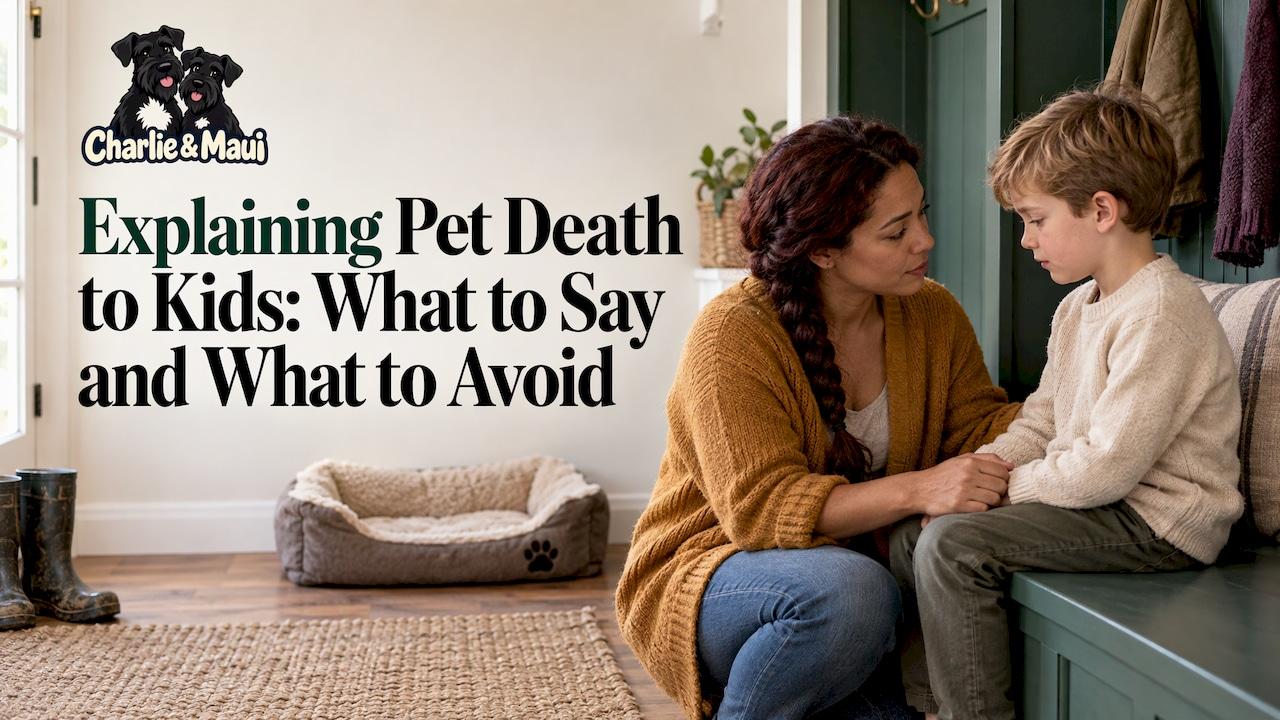
Tell your child the truth in short, concrete words, in a calm and familiar place, using the words "died" and "dead." Then stay close, answer the same questions as often as they come, and give them a way to say goodbye. Pediatric and child-psychiatry sources agree on this, and it works for a three-year-old and a nine-year-old alike, with the wording adjusted to age. A story read together can carry some of the conversation, and the Charlie and Maui books by Charles Jake Jacobs were written for that purpose.
TL;DR
- Use the real words: "died" and "dead." Skip "put to sleep," "passed away" and "went away," which can frighten young children.
- Tell them in a quiet, familiar place, and give a short, honest reason in simple terms.
- Expect the same questions again and again, especially from ages 3 to 5. That is normal, not denial.
- Tell your child clearly that nothing they said, thought or did caused the death.
- Give them a ritual, such as a memory box, a drawing or a planted tree, and read a story about loss together.
Table of Contents
- How to tell your child that a pet has died
- What to say at each age
- Explaining euthanasia, burial and cremation
- When the pet is sick or old and will die soon
- What your child may feel and ask
- Letting them see you grieve
- Ways to remember the pet together
- A story can open the conversation
- A story built for this conversation
- Our perspective
- FAQ
- Sources
How to tell your child that a pet has died
The first conversation sets the tone, and it does not need to be long. The American Academy of Child and Adolescent Psychiatry (AACAP) suggests telling children in a familiar setting, with a soothing voice or reassuring touch, and being honest. Valley Children's Healthcare adds that you should choose a calm, quiet moment and use direct, concrete language rather than waiting for a perfect time.
A simple script for a young child looks like this:
- Say it first. "I have sad news. Maui died today."
- Give a short reason. "She was very old, and her body stopped working."
- Say what it means. "Dead means her body doesn't work anymore. She can't come back."
- Name the feelings and invite questions. "It's okay to feel sad or mad. You can ask me anything."
The order matters. Children listen to the first sentence and often stop absorbing after the second, so put the fact up front and the comfort right behind it.
AACAP also notes that for many children, a pet's death is the first real experience with loss, and that they need consolation, love and affection more than complicated medical or scientific explanations. You do not have to deliver a perfect explanation. You have to be present and truthful.
Words to avoid, and why
Euphemisms feel kind to adults, but literal-minded children take them literally. The Children's Hospital of Philadelphia warns that phrases like "passed away" or "gone to sleep" can create fear, leading children to search for the lost loved one or fear going to bed. The American Kennel Club quotes an expert who points out that telling a three-year-old a dog went to sleep could be terrifying, especially at nap time.
PBS KIDS for Parents lists several more to retire with preschoolers: "passed away," "got a really bad owie," "went to Heaven" and "has gone to sleep and won't wake up". Young children think in a very simple, direct way, so they may start to fear ordinary bumps, trips or falling asleep. A "trip" or "a farm" invites the question of when the pet is coming home.
If your family has spiritual beliefs about what happens after death, you can share them. Put them after the plain fact, not in place of it: "Maui died. Our family believes..." The child hears the truth first and your beliefs second.
What to say at each age
How a child understands death changes a great deal between preschool and the early school years. AACAP describes the pattern: children 3 to 5 see death as temporary and potentially reversible, children 6 to 8 begin to understand it more realistically, and it is generally around age 9 that they fully grasp that it is permanent and final. If you want a longer look at that progression, we wrote about how children understand death at every age.
| Age | How they tend to think | What helps |
|---|---|---|
| 3 to 5 | Death seems temporary. Magical thinking may make them believe they caused it. | Very short, literal sentences. Repeat them as often as needed. Reassure them it was not their fault. |
| 6 to 8 | A more realistic view is forming. They may start asking how and why. | Honest, simple medical reasons. Room for questions about the body and what happens next. |
| 9 and up | They understand that death is permanent. | More detail if they want it. Space to talk, write or remember in their own way. |
Preschoolers (3 to 5)
The University of Rochester's children's hospital recommends using the words "death," "dying" and "dead" with preschoolers, with explanations such as: the body does not work anymore, the heart does not beat, and she does not breathe. It also says it is normal for a preschooler to "forget" that someone died, so you may need to remind them many times.
The Mayo Clinic describes preschoolers as living in a world of magical thinking, where they may believe something they did, thought or said caused the death. That is why the sentence "This is not your fault" belongs in the very first conversation, not only later.
School-age children (6 to 9)
Valley Children's Healthcare notes that school-aged children may generalize what they learn about permanence and begin to worry about other pets, family members or even themselves dying. When that worry surfaces, answer it directly and calmly: you are healthy, you are taking care of them, and most people live a long time. The Children's Hospital of Philadelphia suggests that for ages 6 to 9, memory-making activities, sharing stories about the one who died, and modeling grief responses all help.
Explaining euthanasia, burial and cremation
Many pets die after a veterinarian helps them, and children often overhear the term. Do not hide it. The Ohio State University Veterinary Medical Center's guide recommends explaining euthanasia in developmentally appropriate terms: the veterinarian gives a medicine that only works on animals, it stops the heart, and the pet does not feel pain.
That guide also advises explaining what will happen to the body. If the pet is cremated, say it will be taken to a pet crematory and turned into ashes, and avoid words like "fire" or "burn," which can be scary. If the pet is buried, explain that it will be placed in a box or casket and put in the ground.
Purdue University's veterinary hospitals note that children ages 2 to 6 may fear a buried pet will wake up. If your child asks, repeat the key fact: a dead body cannot feel, wake up or be hurt.
Avoid "put to sleep" as a standalone phrase. The AMC New York guide to supporting children lists it among terms to skip, along with "gone to a better place" and "left us," and offers plain alternatives like "Her body stopped working and she died".
When the pet is sick or old and will die soon
If you know the loss is coming, use the time. HealthyChildren.org, the American Academy of Pediatrics' parent site, advises against hiding how serious things are or saying everything is fine. Instead, talk in an age-appropriate way, answer questions, and give the child a chance to start processing and to say goodbye, so the death is not a huge shock.
The Fred Rogers Institute adds that early conversations may help you understand what support your child will need once the pet has died.
A few ways to use that time:
- Tell your child what is happening in one or two honest sentences: "Charlie is very old and very sick, and the medicine isn't helping anymore. He is going to die soon."
- Let them choose a goodbye: a last walk, a favorite treat, a photo together, a drawing for the pet.
- Say what will happen on the day, in the words above, so nothing about the vet visit is a surprise.
Children are often better at handling honest, sad news than at handling a secret they can sense.
What your child may feel and ask
Expect more than sadness. AACAP lists sadness, anger, fear, denial and guilt, and even jealousy of friends who still have pets. The questions it names are the ones most parents hear: why did the pet die, was it my fault, what happens to the body, will I see the pet again, can I make the pet come back, does death last forever?
The same question, again
A four-year-old may ask on Tuesday when the dog is coming back, right after understanding on Monday that the dog died. The Mayo Clinic says this is normal at this stage of development and that you may need to explain the same information repeatedly. Valley Children's makes the same point: repeated questions from a preschooler are not denial but reflect a developing understanding of the world.
Answer each time as if it were the first, in the same short words. Consistency is the comfort.
"Was it my fault?"
Say it even if they do not ask. The AMC New York guide suggests reassuring children that their thoughts and feelings did not hurt the animal, that they are safe, that the family members are not going to leave them, and that the animal did not choose to die. A child who once yelled "I hate you!" at the dog needs to hear that words cannot make a pet die.
Play, retelling and "I don't know"
Do not be alarmed if your child acts out a funeral with stuffed animals. Purdue's veterinary hospitals note that young children may process grief during play, and the American Kennel Club adds that children under six may play-act the death or pretend the dog is still alive. Telling the neighbors "our dog died" is also a way of trying out new words and checking that death is real.

You also do not need every answer. The Children's Hospital of Philadelphia suggests that if you do not know, you can say you do not know the answer but will try your best to find out.
Letting them see you grieve
Children copy what they see. The Dougy Center and DoveLewis guide on pet loss notes that children model your behavior, so sharing what you feel creates space for them to express their own, and that they need to know it is normal to feel sad, angry, guilty or anything else. Crying in front of your child is not a failure. Saying "I miss her too, and it's okay to be sad" teaches them how grief sounds.
Dr. Ashley Phillips of Valley Children's puts the goal simply: children do not need us to fix their grief, they need permission to feel it and company while they do. HealthyChildren.org says the natural urge to shield a child from unpleasant feelings should be resisted, because a pet's death is also an opportunity to develop coping skills that help throughout life.
Ways to remember the pet together
A small ritual gives grief somewhere to go. HealthyChildren.org suggests a small memorial such as scattering ashes, making a memorial collage or planting a tree, done gently and following the child's wishes.
More ideas, by effort level:
- Ten minutes: draw a favorite memory, or finish the sentences "my favorite thing about her was..." and "what I miss is..." The Dougy Center guide suggests writing prompts like these and memorial art, including Play Doh models and collages.
- An afternoon: build a memory box or photo album, a project Valley Children's lists among ways to remember a pet.
- Something to carry: the Dougy Center suggests a linking object, such as a bracelet with the pet's name or a small painted rock to keep in a pocket.
- Something ongoing: mark the pet's birthday or adoption day, or donate supplies to a local animal shelter, both on the Valley Children's list.
Let your child lead. Some want to make something right away. Others come back to it a month later.
A story can open the conversation
The Ohio State guide recommends that parents of 3-to-5-year-olds read to the child from an age-appropriate book about loss and encourage feelings through play, talking or drawing. A story helps because the child can talk about a character's feelings before they are ready to talk about their own. "Why is Charlie so quiet?" is easier to ask than "Why do I feel so sad?"
The Fred Rogers Institute observes that a child may feel their pets are a part of them, especially when the pet has been in the family their whole life. A story that treats the bond as real tells the child their sadness makes sense.
If you are choosing books for this age more broadly, our guides to read-aloud books for 4-year-olds and books to read aloud to 5-year-olds cover what holds a young listener.
A story built for this conversation
The Charlie and Maui books follow two dogs on adventures about curiosity, kindness and friendship. One story follows a dog coping with the death of a friend. Each book is illustrated and made for ages 4 to 9 to read with an adult, and each includes conversation questions, memory activities and author notes, so you do not have to invent the first words yourself.

The books are available in print and digital editions through online retailers and the author's website. You can see the full line on the Charlie and Maui page.
Our perspective
When I write about loss, I write from my own life: my years in the U.S. Navy and my family. Children feel big things, and they feel them honestly. What they often lack is a way in.
That is why Charlie and Maui are dogs. A child can watch a dog miss a friend and recognize the feeling without having to say "that's me." The conversation questions and memory activities in each book are there so a parent or teacher can pick up from the story and keep going.
The best thing a grown-up can do is sit down, read together, and let the child lead. We built these books to make that first sit-down easier.
Jake
FAQ
How do I explain pet death to a 3-year-old?
Use a few concrete sentences: "Bella died. Her body stopped working. She can't come back." Use the word "died" and avoid "sleep" or "went away." Expect to repeat this many times, because children this age see death as temporary and reversible.
Should I say the pet was "put to sleep"?
It is best not to. Hospitals and pediatric sources warn that sleep phrases can make children fear bedtime. Explain instead that the veterinarian gave medicine that stopped the pet's heart, and that the pet felt no pain, as the Ohio State guide describes.
Should my child attend the vet visit or a burial?
There is no single rule. Describe what will happen in plain terms first, then let your child choose whether to take part. A smaller ritual, such as a drawing, a planted tree or a family goodbye at home, also works, as HealthyChildren.org suggests in its advice on memorials.
My child doesn't seem upset. Is that normal?
Often, yes. Young children grieve in short bursts and in play, and may go back to their games minutes later. Keep the door open, watch for feelings that show up in drawing or play, and answer questions whenever they come.
Is there a book that helps with this?
Yes. A story about loss gives you shared language to start from. The Charlie and Maui books include a story about a dog coping with a friend's death, with conversation questions and memory activities for families to use together.
Sources
- Death of Pets: Talking to Children, AACAP
- Helping Children Cope with the Serious Illness or Death of a Companion Animal, Ohio State University Veterinary Medical Center
- When a Pet Your Child Loves Dies, Fred Rogers Institute
- Helping Your Child Navigate the Loss of a Pet, Valley Children's Healthcare
- When a Pet Dies: How to Help Your Child Cope, HealthyChildren.org
- Explaining Death to a Child, Children's Hospital of Philadelphia
- How to Explain a Pet's Death to Children, American Kennel Club
- Talking with Preschoolers About the Death of a Pet, PBS KIDS for Parents
- Supporting a Grieving Preschooler, University of Rochester Medicine
- Helping Children Grieve: For Parents of Preschoolers, Mayo Clinic
- Children and Pet Loss, Purdue University Veterinary Hospitals
- Supporting the Whole, AMC New York
- After the death of a pet or companion animal, Dougy Center and DoveLewis