
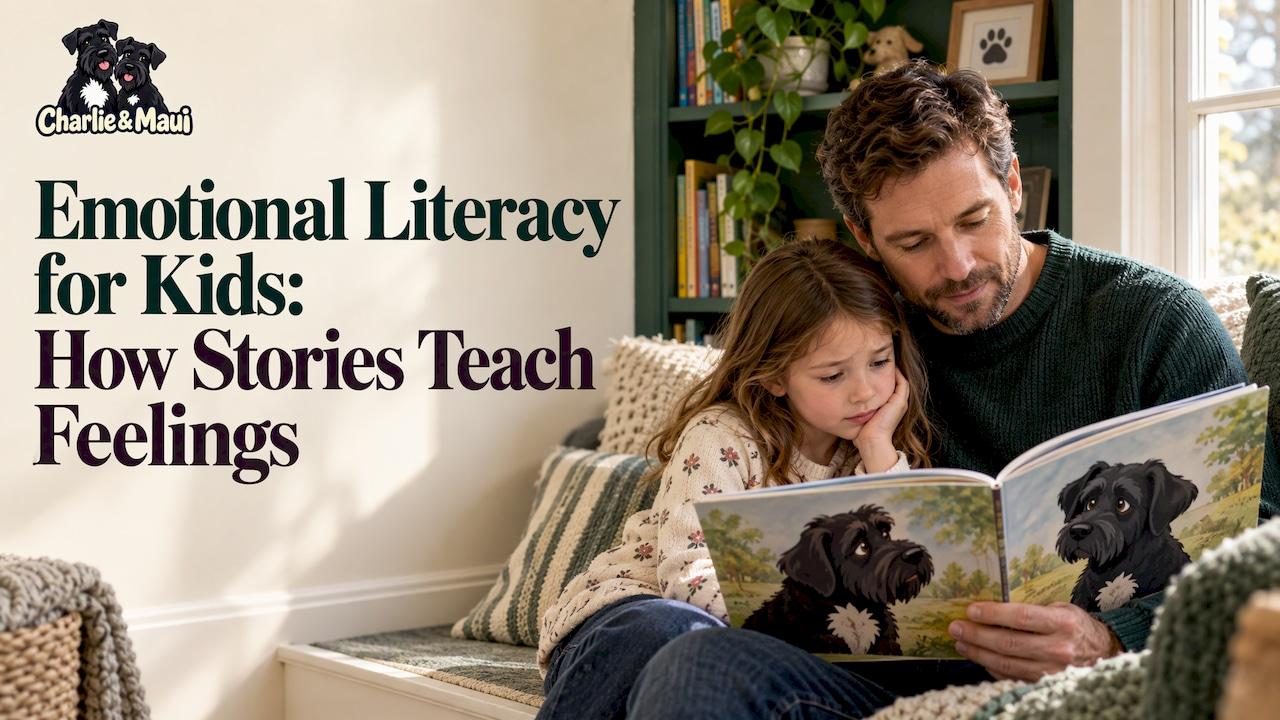
Emotional literacy is a child's ability to recognize, name, understand and express feelings, and one of the easiest places to build it is a picture book read together. A story gives a child a safe character to watch, a feeling to name and an adult to talk with. That is how we write the Charlie and Maui books: illustrated stories about two dogs, with conversation questions, memory activities and author notes for ages 4 to 9 to read with an adult.
TL;DR
- Emotional literacy means recognizing, understanding, labeling, expressing and regulating emotions, according to the U.S. Institute of Education Sciences.
- Reading about feelings together helps children recognize their emotions and build empathy, and calm moments prepare them for stressful ones, says the American Academy of Pediatrics.
- Pause the story and ask what the character feels, what shows it, and whether your child has felt the same.
- Stories about friendship, kindness and loss open conversations that are hard to start cold.
- Go at your child's pace: preview sensitive books and let children return to them when ready.
Table of Contents
- What emotional literacy means for a child
- Why stories work so well
- Questions to ask while you read
- Friendship, kindness and curiosity
- When the feeling is loss
- Using stories in the classroom
- A weekly rhythm that works at home
- Meet Charlie and Maui
- Perspective
- FAQ
- Sources
What emotional literacy means for a child
The Institute of Education Sciences describes emotional literacy as a set of skills: recognizing, understanding, labeling, expressing and regulating emotions. These skills are meant to support self-regulation, social competence and school readiness, according to its description of a preschool program.
In plain terms, a child with these skills can say "I'm disappointed" instead of throwing the game board. They can notice that a friend looks sad. They can also find a way to feel better. None of this arrives automatically. Children learn the words and the ideas from adults who use them, again and again, in ordinary moments.
A simple ladder helps:
- Notice. "My tummy feels tight."
- Name. "I think I'm nervous."
- Understand. "I'm nervous because I don't know the other kids."
- Express. "Can you stay with me for a minute?"
- Cope. Breathing, a hug, a quiet corner, a favorite story.
Most kids between 4 and 9 are climbing the middle rungs. Stories let them practice them without the pressure of their own big feelings.
Why stories work so well
A character's feelings are easier to talk about than your own. When a dog in a book looks worried, a child can say so without admitting anything about themselves. The pediatricians' guidance says reading books about common feelings together can help children recognize their emotions and develop empathy, and that talking about feelings while everyone is calm prepares them for stress and overwhelm (HealthyChildren.org).
Harvard's Making Caring Common frames it nicely: stories can be windows into other people's lives, mirrors for seeing ourselves, and routes to using what we learn every day.
Animal characters add something useful. A dog cannot say "I feel left out." The illustrations and the story have to show it: drooping ears, a slow walk, a toy left in the corner. That pushes children to read body language and context, the same clues they need with people. For more on this approach, see our guide to emotional learning through stories.
Questions to ask while you read
You do not need a script, but a few questions go a long way. Several university and public-media sources point in the same direction.
Pause on the clues. PBS KIDS for Parents suggests stopping to ask what a character is feeling and which words, facial expressions or body language show it. Then ask if your child has felt the same way (PBS KIDS).
Ask why. Texas A&M's College of Education recommends asking how a character feels, why, and how those feelings might change if the situation or the ending changed (Texas A&M).
Invite coping ideas. The Watson Institute suggests asking how a character might feel and why, then letting children propose ways the character could cope (Watson Institute).
Tie it to their life. Greater Good in Education advises not stopping at the character. Link the discussion to the child's own feelings and experiences to deepen perspective taking (Greater Good in Education).
Try more than one point of view. Making Caring Common also suggests asking how different characters might see the same event, and sharing your own interpretation out loud (Making Caring Common).
A quick set to keep on hand:
| Moment | Try asking |
|---|---|
| A character looks upset | "What do you see that tells you how they feel?" |
| After a conflict | "Why do you think that happened?" |
| A friend helps | "How do you think that felt for both of them?" |
| A feeling you recognize | "Has that ever happened to you? What helped?" |
| A sad ending | "What might make the character feel better?" |
Keep it short. One or two questions per sitting is plenty. If a child just wants to hear the story, let them: the questions can wait for the second reading.
Friendship, kindness and curiosity
The everyday feelings come first: excitement before an outing, jealousy over a toy, pride after helping. Picture books about friendship are a standard recommendation. ZERO TO THREE's list of books about feelings includes friendship titles for babies, toddlers and young children, alongside books on anger, fear and self-control (ZERO TO THREE).
NAEYC also describes picture books as a way for early educators and families to foster self-regulation and literacy while discussing self-concept, friendship and bullying (NAEYC, 2024).
The Charlie and Maui stories are built around adventure, curiosity, kindness and friendship, so there is plenty to pause on. When Charlie and Maui set off on a journey, you can ask what each dog is excited or unsure about, and what a good friend does next. If you are choosing among titles, our practical guide to choosing books for children walks through age and theme.

When the feeling is loss
Loss is the hardest feeling to bring up, and often the one parents most want help with. Head Start's guidance is to choose developmentally appropriate books and use discussion questions and follow-up activities to help children define and communicate difficult emotions, including grief (Head Start). The American Library Association's 2024 early childhood toolkit lists picture books on grief, loss and resilience, including one about a family grieving a pet dog (ALA). Pet loss is, for many children, their first experience of death.
That is the territory one Charlie and Maui story enters: a dog coping with the death of a friend. The book carries memory activities and conversation questions so the family can remember together instead of going quiet. A good primer on what children can grasp at different ages is how children understand death at every age. If the loss is a pet, read explaining pet death to kids.
When choosing and discussing stories about sensitive feelings, supporting children through grief offers further perspective on keeping memories alive.

Going at the child's pace
ZERO TO THREE advises adults to read sensitive books themselves first, to judge whether they suit the family's values and the child's temperament, age and developmental stage. If a child resists finishing a story, set it aside where they can look at it alone and let them come back when ready. Repeated readings can be comforting (ZERO TO THREE).
If a child's grief seems to overwhelm daily life for a long stretch, talk with your pediatrician or a child mental health professional. For gentle everyday wording, see helping a child grieve and grief in children's books.
Using stories in the classroom
Teachers have a ready model. Head Start's Tell Me a Story series says shared stories with social-emotional themes can help families and early-care staff support healthy development and school readiness (Head Start). The University of Nebraska–Lincoln's Read for Resilience pairs books about stressors, loss and grief with reading guides that include questions and activities for connecting to characters (UNL).
A research note for the curious: an Ohio State dissertation on a six-week Head Start dialogic-reading program saw vocabulary and emotion-knowledge scores rise in both groups, though results varied by classroom and the sample was small (Ohio State). The takeaway for teachers is practical: repeated, conversational reading with emotion words is worth building into the week.
A simple classroom routine:
- Read the book once straight through for enjoyment.
- On the second read, stop at two or three feeling moments and ask what clues show the emotion.
- Add a short activity: draw the moment, or share a memory it recalls.
- Post the feeling words the class used so children can reach for them later.
Books that arrive with conversation questions and activities save planning time. That is why each Charlie and Maui book includes them, plus author notes for the adult reading along.
A weekly rhythm that works at home
Consistency beats intensity. Try this:
- Calm moment, same time. Bedtime or after dinner. The pediatric guidance stresses talking about feelings while things are calm.
- One feeling word per story. Pick it together and use it during the day: "You look frustrated, like Maui did."
- Model it yourself. Say "I felt nervous today, so I took a deep breath." Children copy what they hear.
- Revisit favorites. Rereading is not a rut. It lets children notice new details each time. More on this in the benefits of reading aloud.
For a child who resists books, reading with reluctant readers has gentle ideas. Age-specific picks are in read-aloud books for 4-year-olds and books to read aloud to 5-year-olds.
Meet Charlie and Maui
The Charlie and Maui books follow two dogs through adventures that touch on curiosity, kindness, friendship, coping with loss, remembrance and family connections. Each book has illustrated stories, conversation questions, memory activities and author notes, written for ages 4 to 9 to read with an adult. They are available in print and digital through Amazon, Barnes & Noble and the author's website.
You can browse the full line on the Charlie and Maui books page.

Perspective
When I write a Charlie and Maui story, I am drawing on my life as a U.S. Navy veteran and a family man. Moving, missing people and remembering them are real parts of that life, and children feel them too, even when they lack the words.
That is why we put the conversation questions and memory activities right in the book. A feeling is easier to name when a dog is feeling it first, and easier to share when a parent is sitting right there. Our books are designed to make that sitting-together moment simple, whether the story is about adventure, a new friend or saying goodbye.
Emotional literacy is not a lesson you finish. It grows one honest conversation at a time, and a good story is a wonderful place to start.
Jake
FAQ
At what age should I start teaching emotional literacy?
Start as early as you like: ZERO TO THREE recommends books about feelings, friendship and loss even for infants and toddlers. For ages 4 to 9, shared reading with simple questions fits naturally into bedtime or classroom time.
How do I help my child talk about feelings if they clam up?
Start with the character, not the child. Ask what the dog in the story feels and how you can tell. Share a feeling of your own, then invite your child to add theirs whenever they are ready.
Is it okay to read about death and loss with young children?
Yes, when the book suits the child's age and temperament. Read it yourself first, go at your child's pace, and let them return to it later. If grief seems to take over daily life, speak with your pediatrician.
How can teachers use these books in class?
Read the story once for enjoyment, then reread and pause at feeling moments to ask about clues and personal connections. The conversation questions and memory activities in each Charlie and Maui book give you ready prompts.
Sources
- Improving School Readiness with Emotional Literacy, Institute of Education Sciences
- Recommended Reading: Books to Teach Kids About Feelings, HealthyChildren.org
- How to Use Stories to Help Kids Develop Empathy, Making Caring Common
- Practicing Empathy During Storytime, PBS KIDS for Parents
- Storytelling to Understand Emotions, Texas A&M
- How to Build Emotional Vocabulary through Stories and Play, Watson Institute
- Fostering Empathy Through Literature, Greater Good in Education
- Books About Feelings for Babies and Toddlers, ZERO TO THREE
- Partnering with Families, NAEYC
- Tell Me a Story Series, Head Start
- Early Childhood Trauma Toolkit, American Library Association
- Read for Resilience, University of Nebraska–Lincoln
- Dialogic Reading Using Social-Emotional Themed Storybooks, Ohio State University