
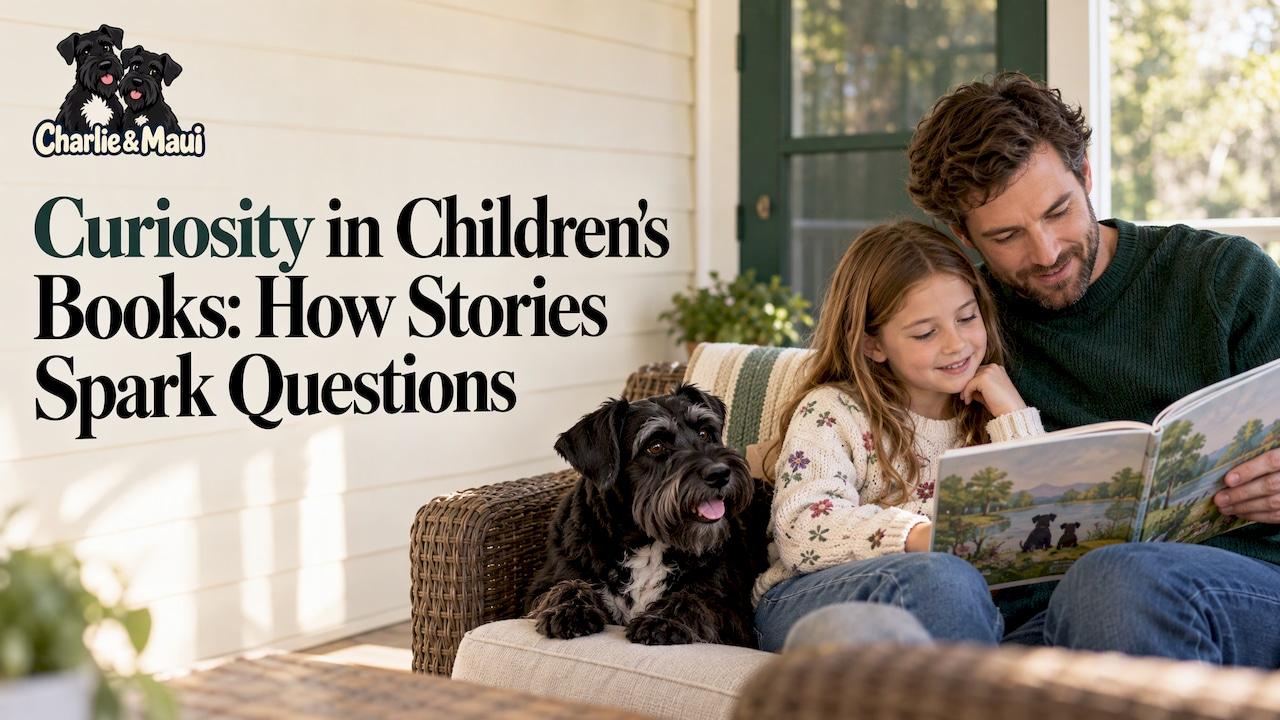
Curiosity in children's books works best when a story gives a child something to wonder about and an adult to wonder with. Pick books with a character who asks, explores and notices, then pause while reading to let your child ask too. Our Charlie and Maui books are written for exactly that kind of shared reading, with conversation questions, memory activities and author notes for ages 4 to 9.
TL;DR
- Curiosity is a normal part of childhood, and research links it to attention, memory and motivation in learning.
- The best curious-minded books ask questions, invite observation and leave room for "what do you think?"
- Animal adventures work well because children follow a character's discoveries and make their own.
- How you read matters as much as what you read: pause, wonder aloud and ask for reasons.
- Our Charlie and Maui books pair illustrated adventures with prompts that keep the questions going.
Table of Contents
- Why curiosity matters for young readers
- What makes a book spark curiosity
- Why animal adventures work so well
- How to read so curiosity grows
- Curiosity about hard things: friendship, family and loss
- Choosing by age
- For teachers: bringing curiosity into the lesson
- Where Charlie and Maui fit
- Our perspective
- FAQ
- Sources
Why curiosity matters for young readers
A 2024 review in Nature Reviews Psychology describes curiosity as a universal characteristic of childhood that can motivate and direct attention while children look for information. In other words, a curious child is already doing the hard work of learning.
Harvard researcher Elizabeth Bonawitz explains in an October 2025 Harvard Graduate School of Education podcast that curiosity activates attention, memory and motivation, preparing the mind to absorb and retain new information. She also reports that more curious children score better in math and reading, and that her lab's studies show simply encouraging children to ask more questions increases curiosity and improves learning.
That last point is the one parents and teachers can act on. Curiosity is not only a trait a child has or lacks. It responds to the way adults invite questions.
Reading Rockets, citing psychologist John Guthrie's work, lists curiosity, the desire to learn about a topic, as one of the kinds of reading motivation. It also notes that highly motivated readers tend to have larger vocabularies and deeper background knowledge. A book that makes a child want to know what happens, or why, is doing more than entertaining.
What makes a book spark curiosity
Not every book that mentions curiosity creates it. Look for these features.
A character who asks and notices
The National Science Teaching Association's guide to choosing children's books suggests looking for books that coach children to ask their own questions and notes that observation is the first science skill for young children. A character who stops, looks closely and wonders gives your child a model to copy.
Questions the text leaves open
A 2022 study by Rybak describes how activity picturebooks invite readers to join in by asking questions and setting tasks, turning the book into a literature of questions and an active dialogue between text and reader. Even a plain story can do this when it ends a page on a puzzle instead of an answer.
Enough depth to talk about
Writing in NAEYC, Hoffman, Teale and Yokota argue that some books give children more to think and talk about than others, and that choosing texts that support richer interpretations makes read-aloud discussions more powerful. A story with feelings, choices and consequences gives a child many places to ask "why?"
A way into the real world
JSTOR Daily reports that classic nature books such as How to Be a Nature Detective invite readers to follow animal tracks and clues, turning ordinary places into spots for observation. The best curiosity books send children outside, or at least around the living room, with new eyes.
Why animal adventures work so well
Children already watch animals closely. A dog sniffs a corner, tilts its head at a sound, runs toward something new. A story built on a dog's journey turns that behavior into a plot: What is over there? Why did it do that? What happens next?

Animal characters also lower the stakes for big feelings. A child can wonder about a character's choices without feeling judged, which makes it easier to talk about kindness, friendship and what it means to miss someone.
For a deeper look at how stories carry feelings, see our guide to emotional learning through stories.
How to read so curiosity grows
The book opens the door. Your voice keeps it open. NAEYC's research summary says reading aloud builds oral language, vocabulary, listening comprehension and content knowledge, and that interactive discussions can extend to analysis and connection-making. Here is a simple routine.
- Look before you read. Ask your child to describe the cover. NSTA notes that observation comes first, so let your child notice details before you supply them.
- Wonder aloud. Say "I wonder why Charlie stopped there." Adults modeling wonder gives children permission to do the same.
- Ask for ideas, then reasons. NSTA suggests adults guide children's natural arguing by asking "What do you think?" and then "What is your reason?"
- Turn why into how. The same guide recommends expanding "why" questions into deeper "how" questions, and asking how something is the same as or different from something your child has seen.
- Take it off the page. NAEYC's 2024 article on science and literacy recommends using props to bring a book to life and encouraging close observation and description of images. A leash, a stick or a photo from your own walk can be enough.
- Let questions stay open. Not every question needs an answer tonight. "Let's find out tomorrow" keeps curiosity alive.
If your child resists sitting down with books, try our notes on reading with reluctant readers, and for ideas beyond the page, see family reading activities.
A worked example
Imagine a page where a dog stops at a closed gate and sniffs. You might ask:
- What do you notice? (observation)
- What do you think is behind it, and why? (idea and reason)
- How is this like the gate at our park? (connection to the world)
- How could Charlie find out? (planning)
Four questions, two minutes, and your child has practiced the same habits researchers describe: observing, predicting and explaining.
Curiosity about hard things: friendship, family and loss
Curiosity is not only about stars and tracks. Children are curious about feelings and about what happens when someone is gone. NAEYC's December 2024 article says that for a young child still developing an understanding of relationships, talking about the death or absence of a family member is an important part of processing loss, and that books can support those conversations.
The University of Arizona's educator guide for the picture book Popo the Xolo makes a similar point: a story about grief and memory can give children a way to talk about death and loss while honoring loved ones through shared stories. A child's questions there are a sign of trust, not a problem to manage.
If this is your family's situation, two guides may help: grief in children's books and helping a child grieve. For a family pet, see remembering a pet with kids. If a child's grief seems to be overwhelming them or lasts and disrupts daily life, talk with your pediatrician or a child counselor.
Choosing by age
Curiosity looks different at each stage, so match the book to the child.
| Age | What curiosity looks like | What to look for in a book |
|---|---|---|
| 4 | Constant "why?" and wanting the same page again | Short scenes, clear pictures, a character who explores |
| 5 to 6 | Predicting, noticing small details | Stories with a puzzle or a choice, space to guess |
| 7 to 9 | Asking how and what if, making connections | Layered stories, feelings, real-world context |
We have more age-specific suggestions in read-aloud books for 4-year-olds, books to read aloud to 5-year-olds and books to read aloud to 9-year-olds. The benefits of reading together are covered in benefits of reading aloud.
For teachers: bringing curiosity into the lesson
JSTOR Daily reports that children's books are used in elementary and middle school to teach inquiry skills such as observing, inferring, posing questions and looking for patterns. A story can do the same job in a reading block. Read a scene, have students list what they notice, then what they wonder, then how they might find out. NAEYC's 2024 guidance suggests focusing on target vocabulary so children can describe what they find.

A story with built-in conversation questions saves planning time, and a memory activity gives students a way to respond in drawing or writing.
Where Charlie and Maui fit
Charlie and Maui are two dogs whose journeys are about adventure, friendship, kindness and curiosity. Each book includes an illustrated story, conversation questions, memory activities and author notes, written for ages 4 to 9 to be read with an adult. The stories are drawn from the author's own life as a U.S. Navy veteran and a family man, and they bring gentle attention to themes such as coping with loss, remembrance and family connections.
You can see the full series on our Charlie and Maui books page.

Print and digital editions are sold through Amazon, Barnes & Noble and our website, so you can read the way your family prefers.
Our perspective
I wrote these books because the best conversations with kids start with a story and a dog. Children who read about Charlie and Maui follow them somewhere new, and the questions come on their own: Where are they going? Why did that happen? What would I do?
Being a Navy veteran taught me that people carry memories, and that talking about them helps. So the books don't stop at the adventure. Each one includes questions to talk through, memory activities to do together and notes from me for the adult holding the book.
Curiosity and kindness grow side by side. A child who wonders about a friend's feelings is a child practicing empathy. That is what I hope families take from Charlie and Maui.
Jake
FAQ
Why is curiosity important in learning?
Curiosity activates attention, memory and motivation, so the mind is ready to take in new information, according to Harvard Graduate School of Education. Researcher Elizabeth Bonawitz reports that more curious children score better in math and reading.
How can I encourage curiosity while reading with my child?
Pause to wonder aloud, ask what your child notices, then ask what they think and why. Moving from "why" to "how" questions takes the thinking a step further, as the NSTA guide suggests.
Why are children's books important?
Reading aloud builds oral language, vocabulary, listening comprehension and content knowledge, according to NAEYC. Shared stories also give families a natural way to talk about feelings and relationships.
Can a story about a pet help children talk about loss?
Yes. NAEYC notes that books can support conversations about a death or absence, which is an important part of helping a young child process loss. Animal characters can make the subject feel safer to approach.
Sources
- Curiosity in children across ages and contexts, Nature Reviews Psychology
- Reading Motivation, Reading Rockets
- Guide to Choosing Children's Books, NSTA
- How Informational Activity Picturebooks Work, Rybak (2022)
- The Book Matters, NAEYC
- Science and Literacy, NAEYC
- Science Lit for Kids Holds a Mirror Aloft, JSTOR Daily
- The Healing Power of Children's Books, NAEYC
- Popo the Xolo Educator's Guide, University of Arizona