
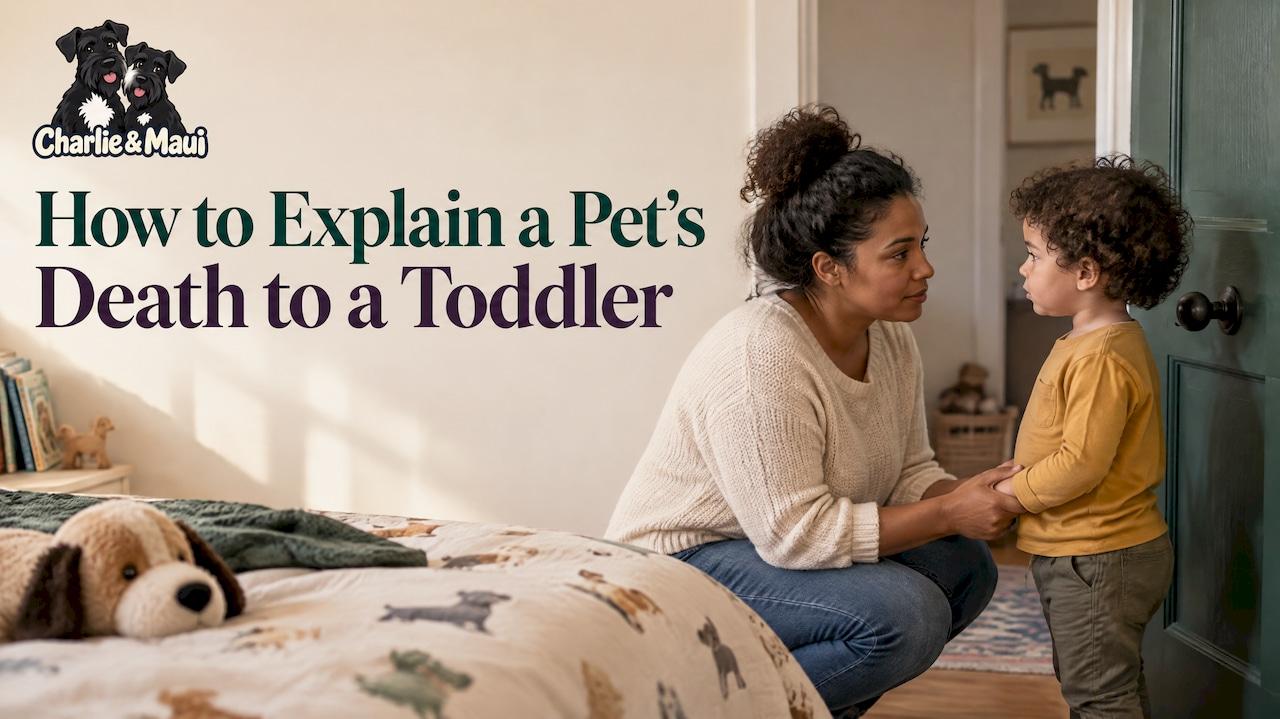
Tell your toddler the truth in a few short, concrete sentences: the pet's body stopped working, the pet died, and you will not see or pet them again. Use the word “died,” skip the euphemisms, say that nothing the child did caused it, and be ready to repeat the answer many times. A toddler cannot grasp that death is permanent, so your calm voice, your honesty and your familiar routines do most of the work.
This guide gives you the words, the phrases to avoid, answers to the questions that come back again and again, small ways to say goodbye, and the signs that a child needs more help.
TL;DR
- Use plain words: “died” and “is dead,” plus one short reason, such as “her body stopped working.”
- Avoid “passed away,” “put to sleep,” “went away” and “went to heaven” as explanations. They can confuse or frighten a very young child.
- Expect the same questions over and over, and tell your toddler clearly that nothing they said or felt caused the death.
- Cry in front of them if you need to, name your feeling, and keep meals, naps and bedtime as normal as you can.
- Offer a small goodbye, such as a drawing, a photo or planting a flower, and talk to your pediatrician if intense grief lasts more than a month.
Table of Contents
- What a toddler actually understands about death
- What to say: simple, literal and true
- When your toddler asks the same question again
- If your toddler thinks it was their fault
- Let them see your feelings, and keep the day steady
- Simple ways for a toddler to say goodbye
- Signs your toddler may need extra help
- Where stories fit in
- Books to read together after a loss
- Our perspective
- FAQ
- Sources
What a toddler actually understands about death
A toddler does not understand death the way you do, and that shapes everything you say. HealthyChildren.org, the American Academy of Pediatrics' parent site, says toddlers have difficulty understanding death. They may keep asking where the pet is, or seem not to care at all. Neither reaction means they are insensitive.
The American Academy of Child and Adolescent Psychiatry explains how this changes with age. Children between 3 and 5 tend to see death as temporary and possibly reversible. Ages 6 to 8 bring a more realistic understanding, and most children do not fully grasp that death is permanent until around age 9. For a toddler, that means a first conversation is only the beginning of many.

There is one more thing to know. PBS KIDS for Parents notes that babies can sense a parent's feelings from as young as three months old. A toddler who loved cuddling the dog or cat will notice the empty spot on the couch, even without grasping why. Your tone and your touch are part of the explanation.
If you want the bigger picture of how understanding grows, our guide to how children understand death at every age walks through each stage.
What to say: simple, literal and true
Children in their first five years think in a very simple, direct way, so literal, concrete explanations work best. PBS KIDS offers a model: say that the pet's heart stopped beating, that her body didn't work anymore and she died, and that this means you will not see her or pet her again.
Children's Mercy suggests similar concrete wording, such as “their heart stopped beating” or “their body is broken and can't be fixed.” The AMC New York guide adds two lines many parents find helpful: “He is dead and won't be alive again,” and “She isn't in pain. She can't feel anything anymore.”
A short script you can adapt
Sit down somewhere familiar and comfortable, hold your child close, and keep it brief. For example:
“I have sad news about Biscuit. Biscuit's body stopped working, and Biscuit died. That means we can't see him or pet him anymore. He doesn't hurt. I feel sad, and it's okay if you feel sad too. I'm here.”
Virginia Tech's veterinary social work program advises talking for a very short time with children aged 2 to 5, being clear and simple, and checking what the child understood. A picture or a bit of play can help show what is happening. If your toddler wanders off to their blocks afterward, that is normal. They can only take in so much at once.
Words to use and words to skip
The guidance is consistent across pediatric and veterinary sources: say “died” and “is dead.” Here is how common phrases land with a very young child.
| Instead of | Why it can backfire | Try |
|---|---|---|
| “Passed away” or “we lost him” | Abstract, and it can suggest the pet is somewhere and could be found | “Biscuit died.” |
| “Put to sleep” or “went to sleep” | Can create fears about sleep | “The vet's medicine helped Biscuit's body stop working so he wouldn't hurt.” |
| “Went away” or “left us” | Can make a child feel rejected or abandoned, or imply a return | “Biscuit didn't choose to leave. His body stopped working.” |
| “Got a bad owie” | Can frighten children about ordinary injuries | “Biscuit's body was very sick and the doctors couldn't fix it.” |
| “He was so good that God wanted him” | Children may become angry with God or fear being chosen next | Share your family's beliefs separately, after the plain facts. |
The Ohio State University veterinary guidance also warns against blaming the veterinarian for the death, since that can create a fear of health care providers.
Why does this honesty matter so much? AACAP cautions that protecting children with vague or inaccurate explanations can create anxiety, confusion and mistrust.
Family beliefs are still welcome. Valley Children's Healthcare says it is fine to share what your family believes when it fits. Put the simple facts first, then add your beliefs as something you hold, not as a replacement for them.
When your toddler asks the same question again
You will likely hear “Where's Biscuit?” at the door, in the car, and at bedtime. The OSU veterinary center says young children often ask the same questions repeatedly. AACAP says very young children may need the explanation repeated several times. This is how a toddler builds understanding, not a sign you did it wrong.
A few habits make the repetition easier:
- Answer the same way each time. Use the same short sentence: “Biscuit died. We can't see him anymore. I miss him too.”
- Keep answers brief. Valley Children's says honesty and brevity work best and that parents sometimes over-explain because of their own anxiety. It is fine to admit you don't know something.
- Expect the big questions. “Why did she die?”, “Did it hurt?” and “Will you die?” are common. For the last two, reassure your child that they are safe and that you and the family are not going anywhere. The AMC New York guide recommends this reassurance, and Valley Children's observes that children are less often seeking a perfect answer than reassurance that they can bring questions to you.
Seeing the world as simple and direct also means a toddler may laugh, run around, or act silly right after hearing the news. OSU's guidance says outbursts of laughter, aggressiveness or boisterous activity are normal and should not be punished.
If your toddler thinks it was their fault
Toddlers often believe their wishes and moods can make things happen. A child who yelled “go away!” at the cat last week may quietly decide that is why the cat died. The OSU guidance offers a line to use: “It's okay if you got mad at Socks. Your thoughts didn't hurt him.”
AMC New York suggests frequent reassurance on several points:
- The death was not the child's fault.
- The child is safe.
- Family members are not going to leave or die.
- The animal did not choose to die.
You can say these without being asked. A child who cannot yet put the worry into words may still carry it.
Let them see your feelings, and keep the day steady
You are grieving too, and that is fine. NC State's veterinary college says it is okay for children to see adults being sad. PBS KIDS recommends explaining your tears in words, such as “I'm crying because I'm sad that Sasha died,” because without an explanation children may guess, often wrongly, why the adults are upset. OSU adds that you should say it is the pet's death that makes you sad, so your child doesn't worry they are the cause.
Then protect the rhythm of the day. NC State notes that a normal schedule for meals, bedtime and play helps with coping, and VCA Animal Hospitals says daily routines give days form and focus when loss turns life upside down. For infants and toddlers, Virginia Tech's guidance adds extra physical connection, avoiding separation where you can, and reassuring them that they will always be cared for.
One caution for yourself: Children's Mercy reminds parents to look after their own grief too, since adults need to process their feelings. A steadier you is the best comfort your toddler has.
Simple ways for a toddler to say goodbye
A goodbye does not need to be elaborate. HealthyChildren.org recommends a small memorial or ritual, such as scattering ashes, making a memorial collage or planting a tree. It suggests offering the idea gently and following the child's wishes. OSU's guidance centers on happy shared memories, with ideas like drawing or painting, a memory box or scrapbook, watching videos, or planting a shrub or tree.
For a child under three or four, that might look like this:
- Scribble a picture for the pet together and tuck it in the garden or a memory box.
- Plant a flower or small shrub and let your child help with the watering.
- Look through photos and say one happy memory out loud: “Biscuit loved chasing the ball.”
- Hold a two-minute goodbye where each person says one thing they loved about the pet.
Children's Mercy describes this as helping children “continue bonds” with a pet through reminiscing, stories, art or a small service. It also says it is fine to switch activities if one, like leaving a leash hung up, makes grief symptoms worse.
If you want to gather photos and voices from the whole family into a keepsake, memorial guest book ideas show how collected memories can be turned into something to look back on together. We have more small rituals in remembering a pet with kids.
If the pet is old or ill, you do not have to wait. Children's Mercy says research shows that preparing children ahead of time helps and that talking about death before it happens does not harm them.
Signs your toddler may need extra help
Most toddlers work through a pet's death with time, comfort and routine. Some need more. HealthyChildren.org lists these signs: trouble with daily functioning months later, preoccupation with the dead pet, acting-out behavior, or deep and prolonged sadness. PBS KIDS says to contact a health care provider if a child is particularly upset, repeatedly acts out the death, or reports stomach aches or headaches.
Children's Mercy gives a timeline: if grief is still intense and disrupting life after more than a month, talk to your child's primary care physician. That might look like being unable to sleep, trouble concentrating or aggressive acting out, and the doctor can refer you to a therapist or counselor. If you ever worry that a child may be thinking about suicide, HealthyChildren.org says to call 988 right away.
For more on supporting a child through any loss, see helping a child grieve: what to say, do and read together.
Where stories fit in
Toddlers learn through repetition, and a story is a way to repeat a hard idea gently. As your child grows toward four and beyond, a picture book gives you and them something outside yourselves to look at while you talk. That is the idea behind our books.
They are written for ages 4 to 9 to be read with an adult, which suits a family that has just lost a pet and has a preschooler or an older sibling in the house. If you are choosing for a child this age, our guides to read-aloud books for 4-year-olds and choosing books for children can help.
Books to read together after a loss
Our Charlie and Maui books follow two dogs on adventures about curiosity, kindness and friendship. One story follows a dog coping with the death of a friend. Each book includes an illustrated story, conversation questions, memory activities and author notes, so a read-aloud can lead into the kind of talk this article describes.
You can see the series on the Charlie and Maui books page.

Our perspective
When I write about loss, I write it the way I would want it said to my own family: simply, and with the dogs close by. As a U.S. Navy veteran, I have learned that big feelings are easier to carry when someone sits beside you and names them.
That is why Charlie and Maui's stories hold both the adventure and the hard part. A child can follow a dog who is sad, and the adult beside them can ask, “What do you think Maui is feeling?” That small question opens a door that “How are you feeling?” sometimes cannot.
The conversation questions, memory activities and author notes in each book are there for that moment. They give you a place to start, so you are not searching for words while your own heart is heavy.
A pet's death is often a child's first experience with loss. I believe a warm, honest story, read together, is one of the best ways to make that first experience a gentle one.
Jake
FAQ
Should I tell my toddler the pet “went to sleep”?
No. Children's Mercy warns that phrases like “gone to sleep” can confuse children and create fears, especially about sleep. Say instead that the pet's body stopped working and the pet died. If your family has beliefs about what comes after, share them after the plain facts.
Does my toddler need to see the body or attend a burial?
It is a choice, and you can follow your child's lead. AMC New York recommends describing in concrete terms what a burial or cremation will involve. HealthyChildren.org suggests offering a goodbye ritual gently and respecting what the child wants.
My toddler doesn't seem sad at all. Is that normal?
Yes. HealthyChildren.org says a toddler who seems unconcerned is not being uncaring, because at this age they do not yet understand what death means. PBS KIDS says both deep sadness and seeming unaffected are normal responses. Keep your routines and answer questions as they come.
Is it okay to cry in front of my toddler?
Yes. Ohio State's veterinary guidance says to let children see you upset so they learn these emotions are acceptable. Add one sentence so they understand the reason: you are sad because the pet died, not because of anything they did.
When should I call the doctor?
Talk to your child's pediatrician if intense grief is still disrupting sleep, behavior or daily life after more than a month, per Children's Mercy. Call sooner if your child seems particularly upset or repeatedly acts out the death. If a child may be thinking about suicide, call 988 immediately.
Sources
- When a Pet Dies: How to Help Your Child Cope, HealthyChildren.org
- Death of Pets: Talking to Children, AACAP
- Talking with Preschoolers About the Death of a Pet, PBS KIDS for Parents
- When a pet dies: How to help your child grieve, Children's Mercy
- Supporting the Whole, AMC New York
- Helping Children Cope with the Serious Illness or Death of a Pet, Ohio State University Veterinary Medical Center
- Children and Pet Loss, Virginia Tech veterinary social work
- Helping Your Child Navigate the Loss of a Pet, Valley Children's Healthcare
- How to Explain the Death of a Pet to a Young Child, NC State College of Veterinary Medicine
- Loss of a Pet: Grief and Bereavement, VCA Animal Hospitals
- Funeral Guest Book Alternatives: Ideas That Capture More, Pomento Blog